Oticon
OTICON OPN 3 MINI RITE POWER (WL)Receiver In The Canal (RIC) Hearing Aid
₹125,000MRP
Technology
AI-PoweredNoise CancellationTinnitus MaskingBluetoothRechargeable
Style
RIC
Available Colors
BlackSandy BrownBrownGreySilverDark ChampagnePearl WhiteDeep BrownBlack GlossBeige
Suitable For
Mild Hearing LossModerate Hearing LossSevere Hearing Loss
✅ Free 3-day home trial·🚚 Cash on delivery·🛡️ Genuine warranty
The Oticon Opn 3 miniRITE Power (WL) Receiver-In-The-Canal (RIC), also referred to by Oticon as Receiver-In-The-Ear (RITE), Hearing Aid is a compact wireless hearing solution developed for individuals who require increased amplification while also preferring a discreet, modern and practical hearing-aid design. It combines Oticon's Velox digital processing platform with OpenSound technology, advanced speech processing, automatic environmental sound management, feedback control, directional processing, wireless connectivity and flexible high-output receiver options.
The Opn 3 belongs to the original Oticon Opn family and uses Level 3 OpenSound Navigator. The Opn concept was designed to provide access to multiple sound sources rather than relying entirely on a conventional approach that focuses on one sound source in front of the wearer. Opn 3 provides 50% balancing power and up to 3 dB maximum noise removal within the documented OpenSound Navigator configuration.
The Opn 3 platform provides 48 processing channels, 12 fitting bands and an 8 kHz fitting bandwidth. Its documented processing features include Speech Guard LX Level 3, Soft Speech Booster LX, Speech Rescue LX, Spatial Sound LX with two estimators, Feedback Shield LX, Wind Noise Management, Transient Noise Management, YouMatic LX, multiple directionality options and Adaptation Management.
For users who require additional amplification, the Opn miniRITE family can be configured with higher-output receiver options, including Power Receiver Mold 100 and Power Receiver Mold 105. The 105 configuration is the higher-output option and is intended for hearing losses requiring more amplification than the standard miniFit receiver configurations.
Compact miniRITE Power Design
The physical design of the Oticon Opn 3 miniRITE Power is one of its key advantages. The main hearing-aid housing sits discreetly behind the ear, while the receiver is positioned close to or inside the ear canal and connected to the hearing aid through a thin receiver wire.
This receiver-in-the-ear architecture can provide a less noticeable appearance than many conventional larger BTE hearing aids. At the same time, the use of higher-output receivers makes it possible to address greater hearing losses while retaining the compact miniRITE platform.
The actual appearance depends on the receiver, ear coupling, ear anatomy, receiver wire length, hearing-aid color and individual fitting.
For users who require more amplification but prefer a discreet hearing instrument, the miniRITE Power configuration provides a practical balance between physical size and amplification capability.
Power Receiver Options
The Opn 3 miniRITE Power supports high-output receiver configurations. Oticon's documentation identifies Power Receiver Mold 100 and Power Receiver Mold 105 among the compatible power options for the Opn miniRITE platform.
Receiver selection is particularly important because hearing loss varies considerably between individuals.
A lower-output receiver may be appropriate for a person with moderate hearing loss, while a higher-output receiver can be considered when substantially more gain is required.
The audiologist should select the receiver according to the individual's audiogram, required gain, comfortable loudness levels, ear anatomy, acoustic coupling and feedback requirements.
More power is not automatically better. The correct receiver is the one that provides the appropriate output for the person's hearing loss and can be fitted comfortably and safely.
Velox Digital Processing Platform
The Oticon Opn 3 is built on the Velox digital processing platform.
Velox provides the processing capability required for the Opn family's environmental analysis, speech processing, sound management and wireless functions.
The Opn 3 provides 48 processing channels, allowing incoming sounds to be analyzed and processed across multiple frequency regions. It also provides 12 fitting bands, giving the hearing professional several areas in which to adjust amplification according to the individual's audiogram.
This type of frequency-specific processing is important because hearing loss is often different at different frequencies.
For example, a person may have relatively good low-frequency hearing but significantly greater high-frequency loss. The audiologist can adjust amplification accordingly rather than applying exactly the same response across the entire hearing range.
8 kHz Fitting Bandwidth
The Opn 3 provides an 8 kHz fitting bandwidth.
Bandwidth represents the frequency range accessible for gain adjustments during professional fitting.
High-frequency information can contribute to speech clarity, particularly for certain consonants, while low-frequency information contributes to voice fullness and environmental sound.
The availability of an 8 kHz bandwidth does not mean that maximum amplification should be applied to every user across the complete range.
The audiologist must determine how much high-frequency information the wearer can use comfortably and how it should be incorporated into the fitting.
OpenSound Navigator Level 3
OpenSound Navigator is a defining feature of the Opn family.
The Opn 3 uses Level 3 OpenSound Navigator, providing a documented 50% balancing power effect and up to 3 dB maximum noise removal.
The system continuously analyzes the surrounding acoustic environment and manages competing sounds while maintaining access to speech and other relevant sound sources.
Rather than focusing exclusively on one person directly in front of the user, the Opn concept is designed around access to a broader sound environment.
This can be useful during social situations in which several people may be speaking or when useful environmental sounds are coming from different directions.
The Opn 3's Level 3 implementation provides this open-sound approach at its specific technology level. It should not be described as having the higher OpenSound processing levels of Opn 1 or Opn 2.
Speech Guard LX Level 3
The Opn 3 incorporates Speech Guard LX Level 3.
Speech is not a constant sound. Natural conversation contains rapid changes in intensity, rhythm and acoustic structure.
Speech Guard LX is designed to preserve important speech variations while providing appropriate amplification.
This helps prevent speech from becoming unnecessarily flat or overly processed.
For hearing-aid users, maintaining useful speech dynamics can be important because small variations in speech provide information that contributes to understanding.
The actual benefit depends on the individual's hearing loss, speech discrimination ability, acoustic surroundings and professional fitting.
Soft Speech Booster LX
The Opn 3 includes Soft Speech Booster LX.
Soft voices can be particularly difficult for people with hearing loss.
A speaker may talk quietly, a family member may speak from nearby without raising their voice, or someone may speak in a calm conversational manner.
Soft Speech Booster LX is designed to provide additional support for softer speech sounds without simply increasing the volume of every sound in the environment.
This can be especially useful for quiet conversations at home, communication with children, and other situations in which speech occurs at lower levels.
The audiologist can personalize the overall gain and processing so that soft speech becomes more accessible while louder sounds remain comfortable.
Speech Rescue LX
The Opn 3 includes Speech Rescue LX.
High-frequency hearing loss can make certain speech cues difficult to detect.
Speech Rescue LX uses frequency composition to help make selected high-frequency information available in a lower frequency region where it may be more accessible to the listener.
This can be useful for appropriately selected users with significant high-frequency hearing difficulty.
The audiologist should determine whether Speech Rescue is suitable for the individual and configure it carefully so that the resulting sound remains clear and comfortable.
Spatial Sound LX
The Opn 3 provides Spatial Sound LX with two estimators.
Spatial sound processing is designed to preserve information about the location and character of sounds in the surrounding environment.
Sound naturally arrives from multiple directions.
During a conversation, one person may be positioned in front of the user while another sound originates from the side. Traffic, household sounds and other environmental information can also come from different directions.
Maintaining this spatial information can help support awareness of the broader acoustic environment.
The Opn 3 has two Spatial Sound estimators, while the premium Opn 1 configuration uses four.
Multiple Directionality Options
The Opn 3 supports multiple directionality options.
Directional processing can increase the relative emphasis placed on useful sound sources while managing selected competing sounds.
The appropriate response can vary according to the listening environment.
For instance, a face-to-face conversation may benefit from a different microphone response than a quiet one-to-one conversation or a noisy social gathering.
The hearing aid can automatically use its directional processing according to the detected environment, reducing the need for constant manual adjustment.
Feedback Shield LX
The Opn 3 includes Feedback Shield LX.
Acoustic feedback occurs when amplified sound escapes from the ear and is picked up again by the hearing-aid microphones, creating a whistling or squealing sound.
Feedback management is especially important when using Power receivers because higher amplification can increase the possibility of acoustic feedback.
Feedback Shield LX is designed to help control unwanted feedback while maintaining useful amplification.
However, electronic feedback management does not replace appropriate receiver selection and acoustic fitting.
The receiver, ear coupling, ear anatomy, gain level and physical condition of the fitting all influence feedback performance.
Wind Noise Management
The Opn 3 incorporates Wind Noise Management.
Wind can produce significant microphone noise, particularly during outdoor activities.
Wind noise may interfere with conversations and can make wearing a hearing aid less comfortable.
Wind Noise Management is designed to reduce wind-generated microphone noise while retaining access to useful speech and environmental sounds.
This can be useful during walking, travel, commuting, outdoor social activities and other situations in which wind reaches the microphones.
Transient Noise Management
The Opn 3 includes Transient Noise Management, documented as an on/off feature at this technology level.
Transient sounds are sudden, short-duration sounds such as dishes contacting a surface, doors closing, objects falling or other sharp environmental events.
These sounds can sometimes seem unexpectedly loud after hearing-aid fitting.
Transient Noise Management is designed to reduce the prominence of such sounds while preserving access to ongoing speech and useful environmental information.
It forms part of the overall listening-comfort strategy of the Opn platform.
YouMatic LX
The Opn 3 includes YouMatic LX with one documented configuration.
YouMatic is designed to personalize hearing-aid behavior according to the user's listening preferences.
People do not necessarily want the same balance of speech emphasis, environmental awareness and sound comfort.
The audiologist can use YouMatic LX as part of the fitting process to establish an appropriate automatic response.
The Opn 3 has one YouMatic LX configuration, compared with two on Opn 2 and three on Opn 1.
Adaptation Management
The Opn 3 includes Adaptation Management.
For first-time hearing-aid users, amplified sound can initially feel unfamiliar.
Sounds that have been difficult to hear for a long period may become noticeable once amplification is introduced.
Adaptation management allows the hearing professional to control the transition toward the intended fitting.
The adaptation level can be adjusted according to the user's comfort, hearing loss, previous hearing-aid experience and real-world response.
Wireless TwinLink Technology
The Opn platform uses TwinLink wireless technology, combining communication between compatible hearing aids with 2.4 GHz wireless connectivity to external digital devices.
This allows two compatible hearing aids to exchange information while also providing wireless audio functionality.
TwinLink was designed to provide stereo wireless streaming with relatively low power consumption.
It is an important part of the Opn platform's communication and connectivity system.
2.4 GHz Stereo Streaming
The Opn 3 supports 2.4 GHz stereo streaming with compatible devices.
This can allow supported audio such as phone calls, music, videos and other digital content to be streamed directly to the hearing aids.
The original Opn platform was also designed as a Made for iPhone hearing aid.
For compatible Apple devices, this can provide direct interaction for audio streaming and phone use. Compatibility depends on the specific device and software version.
Oticon ON App
The Opn 3 supports the Oticon ON App.
The app provides smartphone-based access to selected hearing-aid controls.
Depending on the configuration, users can make adjustments such as volume and program selection.
This provides a discreet alternative to physically changing controls on the hearing instruments.
Because the Opn platform is an older generation, app functionality and device compatibility should be confirmed for the user's particular smartphone.
ConnectClip
The Opn 3 is compatible with ConnectClip.
ConnectClip can function as a remote microphone and wireless communication accessory.
A remote microphone can be particularly useful when the speaker is several metres away or when background noise makes direct conversation more challenging.
The speaker can wear the ConnectClip, allowing their voice to be transmitted wirelessly to the hearing aids.
This can extend the usefulness of the hearing system beyond ordinary acoustic listening.
TV Adapter 3.0
The Opn 3 is compatible with TV Adapter 3.0.
A compatible TV adapter can send television sound directly to the hearing aids.
This can help users who have difficulty separating television dialogue from background music and sound effects.
It also allows other people in the room to maintain the television at a comfortable listening volume rather than increasing it solely for the hearing-aid wearer.
Remote Control 3.0
The Opn 3 supports Remote Control 3.0.
A remote control can provide a simple method of accessing selected hearing-aid functions.
Depending on the programming, users can adjust volume or change programs without directly touching the hearing aids.
This can be particularly useful for people who prefer physical controls or who do not want to use a smartphone for everyday adjustments.
AutoPhone
The Opn 3 includes AutoPhone.
Telephone communication can be challenging because the listener cannot use visual cues such as lip movement.
AutoPhone is designed to help the hearing aid respond appropriately when a telephone is placed near the device.
This can make conventional telephone communication more convenient.
The exact behavior depends on the telephone and the hearing-aid programming.
Tinnitus SoundSupport
The Opn platform supports Tinnitus SoundSupport. The function provides optional sound-support settings that can be configured by a hearing professional for appropriate users.
Tinnitus SoundSupport should not be presented as a cure for tinnitus or as treatment for an underlying medical cause.
Users experiencing persistent, worsening or newly occurring tinnitus should seek appropriate healthcare assessment.
Bass Boost for Streaming
The Opn 3 includes Bass Boost for streaming.
Streaming audio can sometimes have a different tonal character from ordinary acoustic listening.
Bass Boost provides additional control over the low-frequency presentation during supported streamed audio.
Low-frequency information contributes to the sense of fullness in music, video and other entertainment content.
The setting should be adjusted according to the user's preferences and hearing profile.
Power 105 Technical Performance
The technical documentation for the Opn 3 miniRITE 105 identifies approximately 127 dB SPL peak OSPL90, 64 dB peak full-on gain, and a measured frequency range of approximately 100–7500 Hz under the stated test conditions.
These are standardized laboratory measurements describing the technical capability of the Power receiver configuration.
They are not a recommendation that every user receive maximum output.
Actual gain and maximum output must be selected according to the individual's audiogram, speech understanding, comfortable loudness levels and receiver requirements.
Oticon also provides a specific warning for high-output configurations because maximum output capability can exceed 132 dB SPL and excessive output may pose a risk to residual hearing.
Battery and Daily Use
The Opn miniRITE family uses a size 312 battery.
For the miniRITE 105 technical configuration, the published calculated battery life is approximately 110 hours under standardized conditions. Real-world battery life varies according to hearing loss, amplification settings, wearing time, sound environment, wireless streaming, active features and battery quality.
Users who use Power receivers and wireless streaming extensively may experience different battery performance from users with lower amplification requirements.
Keeping spare batteries available is therefore recommended, particularly while travelling or spending extended periods away from home.
Receiver and Acoustic Coupling
Receiver selection is one of the most important parts of fitting an Opn 3 Power device.
The receiver must be selected according to the individual's hearing thresholds and output requirements.
The appropriate acoustic coupling may include a power mould or other compatible ear piece.
The coupling affects sound delivery, comfort, retention and feedback control.
A suitable acoustic seal is especially important when higher amplification is required.
The receiver should be checked regularly for wax, moisture, damage or changes in position.
Who Can Benefit From the Oticon Opn 3 miniRITE Power?
The Oticon Opn 3 miniRITE Power may be considered for individuals who:
Require greater amplification within the selected Power receiver's capability
Prefer a compact and discreet RIC/RITE hearing-aid design
Want 48-channel digital processing
Need 12-band frequency-specific programming
Spend time in a variety of everyday acoustic environments
Want OpenSound Navigator environmental processing
Need support for soft speech
May benefit from high-frequency speech access through Speech Rescue LX
Want feedback management and wind-noise management
Want direct wireless connectivity with compatible devices
Use compatible television streaming
May benefit from a remote microphone through ConnectClip
Want Tinnitus SoundSupport where professionally appropriate
Prefer a discreet hearing aid with Power receiver options
The final suitability should always be determined through professional audiological assessment.
Professional Audiological Fitting
The Opn 3 miniRITE Power should be professionally assessed, selected and programmed.
The audiologist should first conduct an appropriate hearing evaluation.
The correct receiver should then be chosen according to the hearing loss and desired output.
The ear coupling should be selected based on the audiogram, ear anatomy, comfort, retention and feedback requirements.
The device can be programmed using documented Opn fitting formulas including VAC+, NAL-NL1, NAL-NL2 and DSL v5.0.
Follow-up appointments are important because the user's real-world experience may identify situations where additional adjustments are necessary.
The clinician can fine-tune gain, Speech Guard, Soft Speech Booster, Speech Rescue, OpenSound processing, directionality, feedback management, receiver output and other available settings.
Maintenance and Care
Regular maintenance is essential for a RIC/RITE hearing aid.
The receiver and ear coupling should be checked for wax, moisture and physical damage.
Wax accumulation can reduce sound output and may make the hearing aid appear to be malfunctioning.
The hearing-aid housing should be protected from excessive moisture, extreme heat and physical impact.
The receiver and acoustic coupling should be serviced or replaced according to professional recommendations.
The device should not be intentionally immersed in water.
If the hearing aid develops weak sound, distortion, intermittent operation, excessive feedback or unusual battery consumption, it should be professionally inspected.
Everyday Listening Applications
The Opn 3 miniRITE Power can be programmed for many everyday situations.
At home, Soft Speech Booster LX can support access to quieter conversational speech.
During face-to-face communication, OpenSound Navigator, Speech Guard LX and directionality can support access to speech.
In restaurants and social environments, the hearing aid can continuously analyze the surrounding sound environment and manage selected competing sound according to the Level 3 OpenSound configuration.
For outdoor activities, Wind Noise Management can help control microphone noise caused by wind.
For television, TV Adapter 3.0 can provide direct wireless audio.
For compatible smartphones, 2.4 GHz wireless connectivity supports direct streaming.
For conversations in which the speaker is farther away, ConnectClip can function as a remote microphone.
For people experiencing tinnitus, Tinnitus SoundSupport can be professionally configured where appropriate.
Difference Between Opn 3 and Opn 2
The Opn 3 should not be confused with Opn 2.
Both use 48 processing channels and 8 kHz bandwidth, but Opn 2 provides 14 fitting bands compared with 12 on Opn 3. Opn 2 also uses a higher OpenSound Navigator configuration with up to 5 dB maximum noise removal, while Opn 3 provides up to 3 dB. Speech Guard LX is Level 2 on Opn 2 and Level 3 on Opn 3.
Opn 2 also includes Clear Dynamics and Binaural Noise Management in its documented feature matrix, while these are not listed for Opn 3.
Difference Between Opn 3 and Opn 1
The Opn 3 is below Opn 1 in the original Opn technology range.
Opn 1 uses 64 processing channels, 16 fitting bands, 10 kHz bandwidth, OpenSound Navigator Level 1 with up to 9 dB maximum noise removal and four Spatial Sound estimators. Opn 3 uses 48 channels, 12 fitting bands, 8 kHz bandwidth, Level 3 OpenSound Navigator and two Spatial Sound estimators.
The models share the general Opn architecture and several important technologies, but the degree of processing and personalization differs by technology level.
Overall Product Summary
The Oticon Opn 3 miniRITE Power (WL) Receiver-In-The-Canal/RITE Hearing Aid combines a discreet physical design with a Power receiver architecture and Oticon's open-sound processing approach.
The Opn 3 is built on the Velox platform and provides 48 processing channels, 12 fitting bands and an 8 kHz fitting bandwidth. Its documented feature set includes OpenSound Navigator Level 3, Speech Guard LX Level 3, Spatial Sound LX with two estimators, Soft Speech Booster LX, Speech Rescue LX, Feedback Shield LX, Wind Noise Management, Transient Noise Management, YouMatic LX, multiple directionality options and Adaptation Management.
The wireless platform provides 2.4 GHz stereo streaming, Made-for-iPhone functionality, Oticon ON App support, ConnectClip, TV Adapter 3.0, Remote Control 3.0 and AutoPhone, while Tinnitus SoundSupport provides optional professionally configured sound support for users experiencing tinnitus.
The miniRITE Power platform supports higher-output receiver configurations including Power Receiver Mold 100 and Power Receiver Mold 105, allowing the discreet RIC/RITE format to be considered for greater levels of hearing loss than standard receiver configurations.
The Opn 3 miniRITE Power should always be selected and fitted according to the individual's audiogram, speech understanding, receiver requirements, ear anatomy, comfortable loudness levels and lifestyle.
For appropriately selected users, the Oticon Opn 3 miniRITE Power (WL) provides a comprehensive combination of higher-output amplification, open sound processing, speech enhancement, soft-speech support, high-frequency speech access, spatial sound processing, adaptive directionality, feedback management, wind-noise management, wireless connectivity and discreet RIC/RITE design.
More Oticon Hearing Aids
OTICON GO PRO D VC / GO PRO D Behind-The-Ear (BTE) Hearing Aid
OTICON GO PRO POWER D Behind-The-Ear (BTE) Hearing Aid
OTICON GO PRO D In-The-Canal (ITC) Hearing Aid
OTICON GO PRO In-The-Canal (ITC) Hearing Aid
OTICON GO PRO PB Completely-In-Canal (CIC) Hearing Aid
OTICON GO PRO PB POWER Behind-The-Ear (BTE) Hearing Aid
OTICON GO PRO D VC / GO PRO D Behind-The-Ear (BTE) Hearing Aid
OTICON GO PRO POWER D Behind-The-Ear (BTE) Hearing Aid
OTICON GO PRO D In-The-Canal (ITC) Hearing Aid
OTICON GO PRO In-The-Canal (ITC) Hearing Aid
OTICON GO PRO PB Completely-In-Canal (CIC) Hearing Aid
OTICON GO PRO PB POWER Behind-The-Ear (BTE) Hearing Aid
Frequently Asked Questions
What is a Oticon hearing aid?▼
Oticon is a world-leading hearing aid brand known for its advanced technology, exceptional sound quality, and reliability. The OTICON OPN 3 MINI RITE POWER (WL)Receiver In The Canal (RIC) Hearing Aid is one of their premium models designed to help people with hearing loss experience clear, natural sound.
What technology does the OTICON OPN 3 MINI RITE POWER (WL)Receiver In The Canal (RIC) Hearing Aid use?▼
The OTICON OPN 3 MINI RITE POWER (WL)Receiver In The Canal (RIC) Hearing Aid features AI-Powered, Noise Cancellation, Tinnitus Masking, Bluetooth, Rechargeable. These technologies work together to deliver outstanding clarity, comfort, and connectivity for the wearer.
Can I connect the OTICON OPN 3 MINI RITE POWER (WL)Receiver In The Canal (RIC) Hearing Aid to my phone via Bluetooth?▼
Yes, the OTICON OPN 3 MINI RITE POWER (WL)Receiver In The Canal (RIC) Hearing Aid supports Bluetooth connectivity, allowing you to stream audio directly from your smartphone, TV, or other compatible devices.
What is the style and shape of the OTICON OPN 3 MINI RITE POWER (WL)Receiver In The Canal (RIC) Hearing Aid?▼
The OTICON OPN 3 MINI RITE POWER (WL)Receiver In The Canal (RIC) Hearing Aid is available in RIC style(s). RIC (Receiver-in-Canal) designs offer a comfortable fit with excellent sound quality.
What level of hearing loss is the OTICON OPN 3 MINI RITE POWER (WL)Receiver In The Canal (RIC) Hearing Aid suitable for?▼
The OTICON OPN 3 MINI RITE POWER (WL)Receiver In The Canal (RIC) Hearing Aid is recommended for individuals with Mild Hearing Loss, Moderate Hearing Loss, Severe Hearing Loss. We advise getting a professional hearing assessment to confirm the best solution for your specific needs.
What is the price of the OTICON OPN 3 MINI RITE POWER (WL)Receiver In The Canal (RIC) Hearing Aid?▼
The OTICON OPN 3 MINI RITE POWER (WL)Receiver In The Canal (RIC) Hearing Aid is priced at ₹125,000. Insono Hearing offers flexible EMI options and financing. Contact us for the latest offers and to schedule a free trial.
Where can I get a free trial of the OTICON OPN 3 MINI RITE POWER (WL)Receiver In The Canal (RIC) Hearing Aid in India?▼
Insono Hearing offers free trials for the OTICON OPN 3 MINI RITE POWER (WL)Receiver In The Canal (RIC) Hearing Aid at our clinics. Book an appointment online or call us to experience the device before making a decision.
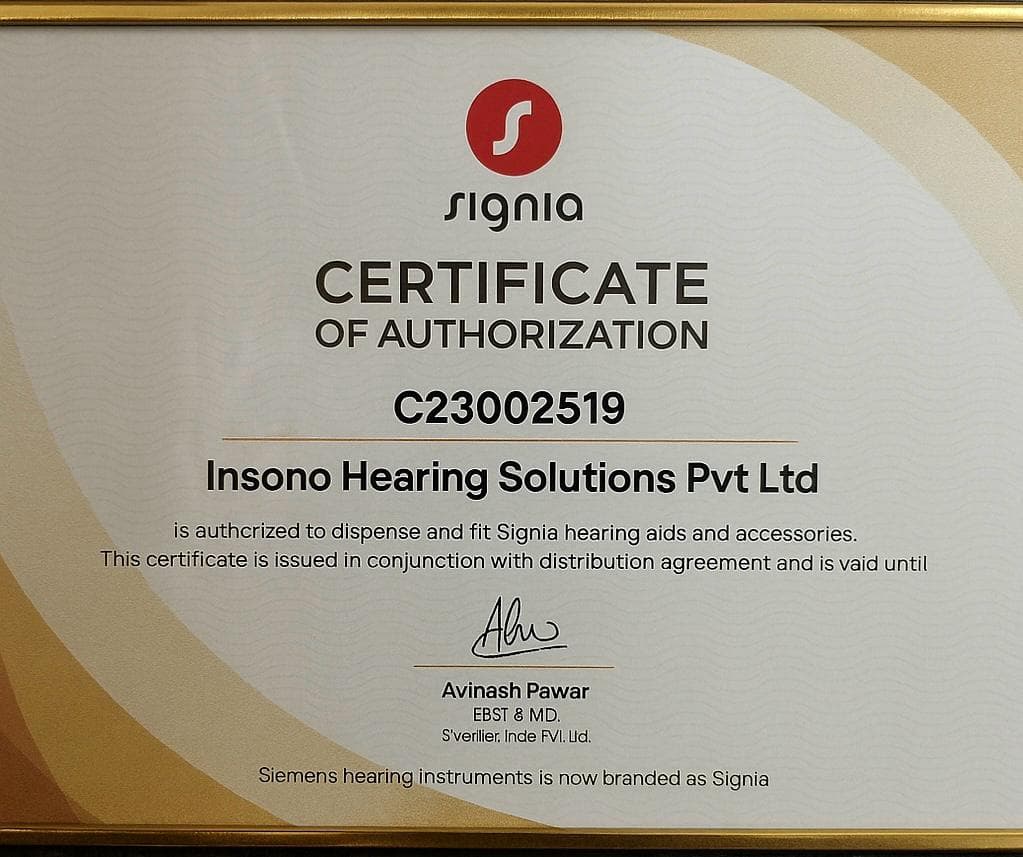
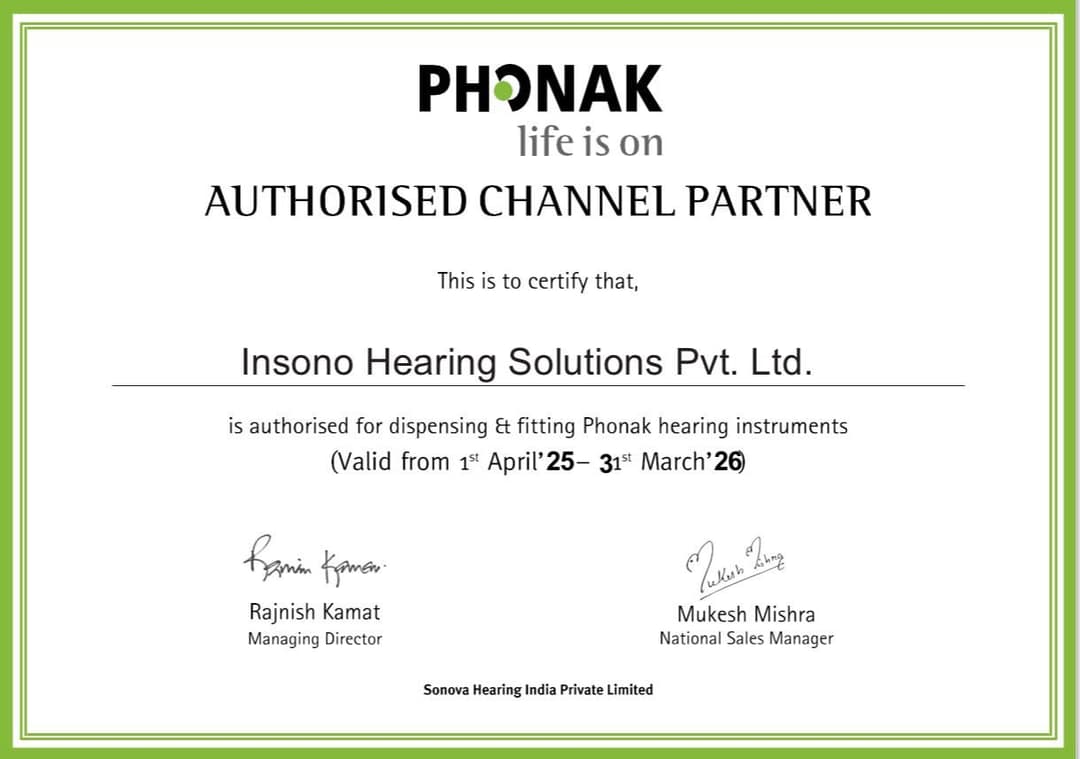
Official Certifications from Widex, Signia & Phonak
Insono Hearing Solutions is an authorized partner for leading global hearing aid brands including Widex, Signia, Phonak, and Oticon. These certifications reflect our trusted expertise and commitment to world-class hearing care in India.

Discover the Different Types of Hearing Aids for Better Hearing
Learn about the latest digital hearing aids, from behind-the-ear (BTE) to completely-in-canal (CIC) devices. Find the right style, features, and comfort level that suit your lifestyle.