Oticon
OTICON INTIGA 8 (WL) Receiver In The Canal (RIC) Hearing Aid
₹175,000MRP
Technology
BluetoothTinnitus MaskingNoise CancellationAI-PoweredRechargeable
Style
RICITE
Available Colors
BlackBrownSandy BrownGreySilverBeigeCosmic BlueDark ChampagnePearl WhiteDeep BrownBlack Gloss
Suitable For
Mild Hearing LossModerate Hearing LossSevere Hearing Loss
✅ Free 3-day home trial·🚚 Cash on delivery·🛡️ Genuine warranty
The Oticon Intiga 8 (WL) Receiver-In-The-Canal, also known as Receiver-In-The-Ear (RITE), Hearing Aid is a compact wireless hearing solution designed for individuals who want a discreet behind-the-ear style combined with personalized digital sound processing, automatic environmental management, directional microphone technology, feedback cancellation, and wireless accessory connectivity.
The Intiga family was developed as a compact hearing-aid platform with an emphasis on comfortable everyday wearing and a discreet appearance. The Intiga 8 sits between the higher-level Intiga 10 and the entry-level Intiga 6, offering an 8-channel processing configuration with a feature set designed to support speech access, listening comfort, and automatic adaptation.
Oticon's technical documentation identifies the Intiga 8 RITE with 8 fitting channels, an 8 kHz fitting bandwidth, TriState Noise Management, Binaural Dynamic Feedback Cancellation 2, Auto Adaptation Manager, three fitting identities, four programs, Multiband Adaptive Directionality, Tri-mode Directionality Automatics, Front Focus, Life Learning, memory, in-situ audiometry, and wireless/ConnectLine capability.
The Intiga 8 uses a very small size 10 zinc-air battery. Oticon's technical information gives a calculated battery life of approximately 80–100 hours under standardized battery-consumption measurements. Actual battery life depends on battery quality, hearing loss, use pattern, active features, and the sound environment.
The RITE configuration places the receiver close to or inside the ear canal while the main electronics remain behind the ear. This design can provide a discreet appearance and a short acoustic pathway between the hearing aid and ear.
Compact RITE Design
The Intiga 8 is designed around a compact Receiver-In-The-Ear architecture.
Instead of housing the receiver inside the main behind-the-ear shell, the receiver is positioned near the ear canal and connected to the hearing-aid housing through a thin receiver wire.
This architecture can provide a discreet appearance because the main instrument is small and sits naturally behind the ear.
The receiver system also allows the hearing professional to select an appropriate receiver according to the user's hearing loss.
Oticon's documentation identifies a standard-performance receiver for Intiga RITE, available in multiple lengths. The receiver is connected to an ear piece or custom micro-mould according to the fitting requirement.
Receiver and Ear Coupling Options
The receiver is one of the most important components of a RITE hearing aid because it delivers amplified sound directly to the ear.
Oticon documents a standard receiver for the Intiga RITE with several available wire lengths. The system can be fitted with appropriate ear coupling depending on the user's anatomy and hearing loss.
A correctly selected coupling contributes to:
Sound quality
Retention
Listening comfort
Feedback control
Appropriate amplification
Stable receiver positioning
Custom ear pieces such as a Micro Mould can be considered when a more controlled acoustic seal or additional retention is required.
The audiologist should determine the appropriate ear piece based on the individual's hearing thresholds, ear anatomy, gain requirements, comfort, and lifestyle.
Eight-Channel Digital Processing
The Intiga 8 is documented with 8 fitting channels.
Channel-based processing allows the audiologist to make adjustments across different frequency regions.
Hearing loss is frequently different at different frequencies. A user may have relatively better low-frequency hearing but significantly reduced hearing in the high frequencies. Another user may have a different hearing-loss configuration.
The eight-channel architecture provides several frequency-specific adjustment areas that can be tailored according to the individual's audiogram.
This helps create a personalized fitting rather than applying exactly the same amplification characteristics across the entire sound range.
8 kHz Fitting Bandwidth
The Intiga 8 provides an 8 kHz fitting bandwidth. Oticon defines fitting bandwidth as the frequency range accessible for gain adjustments during professional fitting.
High-frequency information can contribute to speech clarity, particularly for certain consonant sounds.
Lower-frequency information contributes to voice fullness and many environmental sounds.
The presence of an 8 kHz fitting bandwidth does not mean that every user should receive maximum amplification throughout that range. The audiologist determines the appropriate frequency response based on the individual's hearing loss and comfort.
TriState Noise Management
The Intiga 8 includes TriState Noise Management.
Everyday environments contain many sounds that are unrelated to the conversation the listener is trying to follow. These can include traffic, fans, appliances, air-conditioning systems, machinery, and other people's conversations.
Noise-management technology is designed to reduce the prominence of selected unwanted background sounds while maintaining access to useful speech and environmental information.
The TriState approach provides different levels of processing according to the detected acoustic environment.
The objective is not to eliminate all surrounding sound. Environmental awareness remains important for communication and safety.
Instead, the technology is designed to create a more comfortable balance between important sounds and competing noise.
Multiband Adaptive Directionality
The Intiga 8 incorporates Multiband Adaptive Directionality.
Directional microphone processing can help increase the relative emphasis placed on useful sound sources while managing selected competing sounds arriving from other directions.
The multiband approach allows directional processing to operate across multiple frequency regions.
The adaptive nature of the system means that the hearing aid can respond to changes in the surrounding sound environment rather than maintaining one fixed directional response.
This can be helpful during face-to-face conversations, family gatherings, restaurants, meetings, offices, and other environments with multiple sound sources.
Tri-Mode Directionality Automatics
The Intiga 8 also provides Tri-mode Directionality Automatics.
A hearing aid may need to behave differently in a quiet environment, a speech-focused environment, and a noisy environment.
Automatic directionality allows the device to select an appropriate directional strategy according to the detected acoustic conditions.
The three-mode approach gives the hearing aid several automatic operating states.
This reduces the need for the wearer to manually change the hearing-aid settings every time the listening environment changes.
Front Focus
The Intiga 8 incorporates Front Focus.
During many conversations, the person the wearer wants to listen to is positioned in front.
Front Focus is designed to support attention toward the front while working with the hearing aid's overall directional processing.
This can be useful in one-to-one conversations and other face-to-face listening situations.
It is not intended to eliminate sounds from behind or from the sides completely. Rather, it forms part of the hearing aid's automatic strategy for handling the acoustic environment.
Binaural Dynamic Feedback Cancellation 2
The Intiga 8 includes Binaural Dynamic Feedback Cancellation 2, also referred to as DFC2.
Acoustic feedback occurs when amplified sound escapes from the ear and returns to the microphones, causing a whistling or squealing sound.
Feedback control is especially important in RITE hearing aids because the receiver is positioned close to the ear canal.
The feedback-cancellation system is designed to reduce the conditions that produce unwanted feedback while maintaining appropriate amplification.
However, electronic feedback cancellation does not eliminate the importance of good acoustic fitting.
The ear piece, receiver position, ear anatomy, gain settings, and physical condition of the receiver system all contribute to feedback performance.
Automatic Adaptation Manager
The Intiga 8 includes an Auto Adaptation Manager with First Fit Algorithm.
People who are new to hearing aids may initially find amplified sound unfamiliar.
Sounds that were previously difficult to hear can become more noticeable after fitting.
An adaptation system allows amplification to be managed appropriately during the user's adjustment period.
The professional can use the adaptation functionality to support a gradual transition toward the intended hearing-aid settings.
The correct adaptation level should be determined according to the user's hearing loss, previous hearing-aid experience, comfort, and personal needs.
Artificial Intelligence Advanced [+]
The Intiga 8 technical feature matrix identifies Artificial Intelligence Advanced [+] as part of the model's processing platform.
This terminology belongs to an earlier generation of Oticon technology and refers to automated sound-processing capabilities within the hearing-aid platform.
It should not be interpreted as equivalent to the modern machine-learning and artificial-intelligence technologies found in newer generations of hearing aids.
Its role is part of the automatic environmental-processing architecture of the Intiga family.
Life Learning
The Intiga 8 includes Life Learning, while the lower-level Intiga 6 does not.
Life Learning is designed to help personalize the hearing-aid experience over time by using information about how the hearing aid is used and the user's interactions with it.
This can provide additional support for tailoring the hearing experience to the individual's preferences.
Life Learning should complement professional audiological care rather than replace it.
The user's own feedback remains important when determining whether programming changes are required.
Three Fitting Identities
The Intiga 8 is documented with three fitting identities.
Different users can have different expectations about how amplified sound should be presented.
One user may prefer stronger speech emphasis, while another may prefer a different balance between speech audibility and environmental awareness.
The identity options give the hearing professional additional tools for selecting an appropriate sound profile during fitting.
The chosen identity can then be refined through individual programming and follow-up.
Speech Processing
Speech access is one of the central objectives of the Intiga 8.
People with hearing loss can find conversations difficult because important speech information may be below the level that their hearing system can detect effectively.
The Intiga 8 provides frequency-specific amplification according to the user's hearing thresholds.
Its automatic directionality and noise-management functions then work as part of the overall system to manage speech and background sound.
The Intiga 8 does not include Speech Guard according to Oticon's feature matrix; Speech Guard is listed for Intiga 10 but not Intiga 8.
This distinction is important when comparing the different Intiga technology levels.
Four Listening Programs
The Intiga 8 supports four programs.
Programs allow the audiologist to create different hearing-aid configurations for different listening situations.
Depending on the user's lifestyle, programs may be configured for everyday communication, noisy environments, telephone use, or another specific listening situation.
The actual program arrangement should be customized during professional fitting.
The user can then access the appropriate program through the available control or compatible accessory.
Memory
The Intiga 8 includes Memory functionality.
Memory allows selected settings and configurations to be retained by the hearing instrument.
This supports the use of multiple personalized programs and settings.
The memory functionality forms part of the overall programmable architecture and helps the hearing professional create a configuration suited to the user's daily listening needs.
Wireless Connectivity
The WL version of the Intiga 8 provides wireless functionality within Oticon's wireless ecosystem.
Oticon's Intiga documentation identifies the platform as ConnectLine enabled and compatible with wireless programming through nEARcom cordless programming for the RITE style.
Wireless functionality can extend the hearing aid beyond direct acoustic listening.
Compatible accessories can provide additional options for television, telephone, communication, and other supported audio applications.
The Intiga belongs to an older generation of Oticon wireless technology, so its wireless functionality should not automatically be described as modern direct Bluetooth connectivity to current smartphones.
ConnectLine Compatibility
The Intiga 8 is ConnectLine enabled.
ConnectLine accessories can provide additional ways of accessing supported external audio sources.
For example, compatible television accessories can transmit audio more directly to the hearing aids.
This can be helpful for people who have difficulty distinguishing television dialogue from background music and sound effects.
Depending on the accessory configuration, ConnectLine can also support other communication and audio applications.
T-Coil and Other Connectivity Options
Oticon's Intiga documentation identifies connectivity, including compatibility with the broader wireless ecosystem, while the RITE/other BTE feature matrices identify T-coil/FM/DAI functionality according to supported styles and accessories.
Where an appropriate compatible configuration is used, telecoil can be valuable in venues equipped with hearing-loop systems.
Hearing loops may be available in theatres, auditoriums, lecture halls, meeting rooms, places of worship, and other public spaces.
Users should confirm the exact accessory and style compatibility with their hearing professional because the Intiga RITE is a compact older-generation product.
nEARcom Cordless Programming
The Intiga 8 is documented as nEARcom cordless enabled.
This allows the hearing professional to perform wireless programming using the appropriate fitting equipment.
Cordless programming can make the fitting process more convenient because the hearing aid can be adjusted without requiring the same physical connection used by some wired programming configurations.
Professional programming remains essential to ensure that the amplification and processing correspond to the user's hearing profile.
In-Situ Audiometry
The Intiga 8 supports in-situ audiometry.
In-situ audiometry allows the hearing professional to obtain additional information about the user's hearing response through the fitting system.
This can help the audiologist fine-tune the hearing aid.
The results can be considered together with conventional hearing-test information and the user's own feedback regarding comfort, speech understanding, and sound quality.
Fitting Rationales
The Intiga platform supports several professional fitting rationales, including VAC, NAL, and DSL.
Fitting rationales provide structured starting points for selecting amplification according to the individual's hearing thresholds.
The audiologist can then make additional changes based on the user's hearing response and preferences.
This professional fitting process is particularly important because the same hearing-aid settings will not be appropriate for every person.
Standard Receiver Performance
The Intiga RITE documentation specifies a standard-performance receiver with five available receiver lengths.
Receiver selection is important because the receiver must sit correctly relative to the ear canal.
An improperly positioned receiver can affect sound quality, comfort, retention, and feedback.
The audiologist should select the appropriate receiver length and verify its position during fitting.
ProWax and Wax Protection
The Intiga RITE receiver uses ProWax or NoWax protection, according to the product documentation.
Wax protection is important because earwax can accumulate around the receiver outlet and interfere with sound transmission.
The receiver and wax filter should therefore be checked regularly.
Users should replace the wax filter according to professional instructions when it becomes blocked or contaminated.
Battery and Daily Operation
The Intiga 8 RITE uses a size 10 zinc-air battery.
Oticon's technical data gives a calculated battery life of approximately 80–100 hours under standardized conditions.
Real-world battery life depends on the user's hearing loss, amplification settings, daily wearing time, sound environment, battery quality, and active features.
Because size 10 batteries are relatively small, users should carry spare batteries when travelling or spending long periods away from home.
The battery drawer should remain clean and dry.
Technical Output
Oticon's technical measurements for the Intiga 8 RITE list a peak OSPL90 of approximately 119 dB SPL, an OSPL90 level at 1600 Hz of approximately 112 dB SPL, and an average OSPL90 of approximately 110 dB SPL. The published peak full-on gain is approximately 58 dB, with approximately 44 dB at 1600 Hz and 43 dB average. The measured frequency range is approximately 100–7500 Hz.
These are standardized laboratory measurements describing the technical capability of the device.
They should not be interpreted as the amplification level that every user will receive.
The audiologist determines actual gain according to the hearing loss and comfortable loudness range.
Compact and Discreet Wear
One of the primary advantages of the Intiga 8 is its compact RITE form factor.
The small behind-the-ear housing and thin receiver wire are designed to provide a relatively discreet hearing solution.
This can be particularly appealing to users who are concerned about the visible size of a traditional hearing aid.
The receiver sits close to the ear canal while the main instrument rests behind the ear.
Comfort and retention should always be checked during fitting.
Who Can Benefit From Oticon Intiga 8?
The Oticon Intiga 8 may be considered for individuals who:
Have hearing loss within the receiver's fitting capability
Prefer a discreet RITE/RIC-style hearing aid
Want an 8-channel digital hearing instrument
Need individualized frequency-specific amplification
Spend time in quiet and moderately complex listening environments
Want automatic directionality and noise management
Need feedback cancellation
Want Life Learning functionality
Want wireless compatibility through ConnectLine
Prefer multiple listening programs
Want a small size-10 battery configuration
May benefit from in-situ audiometry and professional wireless programming
Final suitability should always be confirmed through professional audiological evaluation.
Professional Audiological Fitting
The Intiga 8 should be professionally selected and fitted.
The audiologist first assesses the user's hearing thresholds and determines the appropriate amount of amplification.
The correct receiver length and ear coupling are then selected.
The hearing aid can be programmed using an appropriate fitting rationale and customized through the available identities, programs, directionality, noise management, adaptation, and other functions.
Follow-up appointments are important because real-world listening experience can reveal preferences or difficulties that were not apparent during the first fitting.
Maintenance and Care
Regular maintenance is essential for a receiver-in-the-ear hearing aid.
The receiver outlet and wax protection should be checked regularly.
Earwax, moisture, or debris can reduce sound output and may make the hearing aid appear to be malfunctioning.
Oticon recommends cleaning the surface of hearing aids with a soft, dry cloth and states that hearing aids should never be washed or immersed in water or other liquids.
The receiver, ear grip, ear piece, and microphone openings should also be kept clean according to professional instructions.
Everyday Listening Applications
The Intiga 8 can be programmed for a variety of everyday environments.
At home, it can support conversations with family members and access to everyday household sounds.
During face-to-face communication, Front Focus and adaptive directionality can help manage the listening situation.
In restaurants, offices, shops, or social gatherings, TriState Noise Management and adaptive directionality can help manage selected background noise.
For television and compatible external sources, ConnectLine accessories can extend the hearing aid's functionality.
For telephone and other supported applications, the wireless ecosystem can provide additional listening options.
Difference Between Intiga 8 and Intiga 10
The Intiga 8 should not be confused with the higher-level Intiga 10.
Oticon's feature matrix identifies 10 fitting channels for Intiga 10 versus 8 for Intiga 8. Intiga 10 also has 10 kHz fitting bandwidth, Speech Guard, Multiband Adaptive Directionality, TriState Noise Management, a Music Program, five identities, Life Learning, and additional Premium-level processing. The Intiga 8 has 8 kHz bandwidth, no Speech Guard, no dedicated Music Program, three identities, and Advanced-level automatic processing.
This distinction is important when presenting the Intiga 8 in a product catalogue because features from the Intiga 10 should not be attributed to Intiga 8.
Overall Product Summary
The Oticon Intiga 8 (WL) Receiver-In-The-Canal/RITE Hearing Aid is a compact wireless hearing solution that combines an understated physical design with practical digital processing and automatic environmental management.
Its documented feature set includes 8 fitting channels, 8 kHz fitting bandwidth, TriState Noise Management, Binaural Dynamic Feedback Cancellation 2, Multiband Adaptive Directionality, Tri-mode Directionality Automatics, Front Focus, Auto Adaptation Manager, Artificial Intelligence Advanced [+], Life Learning, three fitting identities, four programs, memory, in-situ audiometry, nEARcom cordless programming, and ConnectLine compatibility.
The RITE configuration uses a standard-performance receiver, available in multiple lengths, together with ProWax/NoWax receiver protection and appropriate ear-coupling options.
Technical measurements for the Intiga 8 RITE identify approximately 119 dB SPL peak OSPL90, 58 dB peak full-on gain, a 100–7500 Hz measured frequency range, and approximately 80–100 hours of calculated battery life using a size 10 battery.
The Intiga 8 is particularly notable for its compact RITE design, which places the receiver close to the ear canal and allows the main hearing-aid housing to remain discreet behind the ear.
The model should always be professionally fitted according to the user's audiogram, receiver requirements, ear anatomy, listening needs, comfort, and lifestyle.
For appropriately selected users, the Oticon Intiga 8 (WL) offers a combination of discreet RITE design, personalized digital amplification, adaptive directionality, automatic noise management, feedback cancellation, Life Learning, multiple programs, and wireless accessory compatibility in a compact hearing-aid platform.
More Oticon Hearing Aids
OTICON GO PRO D VC / GO PRO D Behind-The-Ear (BTE) Hearing Aid
OTICON GO PRO POWER D Behind-The-Ear (BTE) Hearing Aid
OTICON GO PRO D In-The-Canal (ITC) Hearing Aid
OTICON GO PRO In-The-Canal (ITC) Hearing Aid
OTICON GO PRO PB Completely-In-Canal (CIC) Hearing Aid
OTICON GO PRO PB POWER Behind-The-Ear (BTE) Hearing Aid
OTICON GO PRO D VC / GO PRO D Behind-The-Ear (BTE) Hearing Aid
OTICON GO PRO POWER D Behind-The-Ear (BTE) Hearing Aid
OTICON GO PRO D In-The-Canal (ITC) Hearing Aid
OTICON GO PRO In-The-Canal (ITC) Hearing Aid
OTICON GO PRO PB Completely-In-Canal (CIC) Hearing Aid
OTICON GO PRO PB POWER Behind-The-Ear (BTE) Hearing Aid
Frequently Asked Questions
What is a Oticon hearing aid?▼
Oticon is a world-leading hearing aid brand known for its advanced technology, exceptional sound quality, and reliability. The OTICON INTIGA 8 (WL) Receiver In The Canal (RIC) Hearing Aid is one of their premium models designed to help people with hearing loss experience clear, natural sound.
What technology does the OTICON INTIGA 8 (WL) Receiver In The Canal (RIC) Hearing Aid use?▼
The OTICON INTIGA 8 (WL) Receiver In The Canal (RIC) Hearing Aid features Bluetooth, Tinnitus Masking, Noise Cancellation, AI-Powered, Rechargeable. These technologies work together to deliver outstanding clarity, comfort, and connectivity for the wearer.
Can I connect the OTICON INTIGA 8 (WL) Receiver In The Canal (RIC) Hearing Aid to my phone via Bluetooth?▼
Yes, the OTICON INTIGA 8 (WL) Receiver In The Canal (RIC) Hearing Aid supports Bluetooth connectivity, allowing you to stream audio directly from your smartphone, TV, or other compatible devices.
What is the style and shape of the OTICON INTIGA 8 (WL) Receiver In The Canal (RIC) Hearing Aid?▼
The OTICON INTIGA 8 (WL) Receiver In The Canal (RIC) Hearing Aid is available in RIC, ITE style(s). RIC (Receiver-in-Canal) designs offer a comfortable fit with excellent sound quality.
What level of hearing loss is the OTICON INTIGA 8 (WL) Receiver In The Canal (RIC) Hearing Aid suitable for?▼
The OTICON INTIGA 8 (WL) Receiver In The Canal (RIC) Hearing Aid is recommended for individuals with Mild Hearing Loss, Moderate Hearing Loss, Severe Hearing Loss. We advise getting a professional hearing assessment to confirm the best solution for your specific needs.
What is the price of the OTICON INTIGA 8 (WL) Receiver In The Canal (RIC) Hearing Aid?▼
The OTICON INTIGA 8 (WL) Receiver In The Canal (RIC) Hearing Aid is priced at ₹175,000. Insono Hearing offers flexible EMI options and financing. Contact us for the latest offers and to schedule a free trial.
Where can I get a free trial of the OTICON INTIGA 8 (WL) Receiver In The Canal (RIC) Hearing Aid in India?▼
Insono Hearing offers free trials for the OTICON INTIGA 8 (WL) Receiver In The Canal (RIC) Hearing Aid at our clinics. Book an appointment online or call us to experience the device before making a decision.
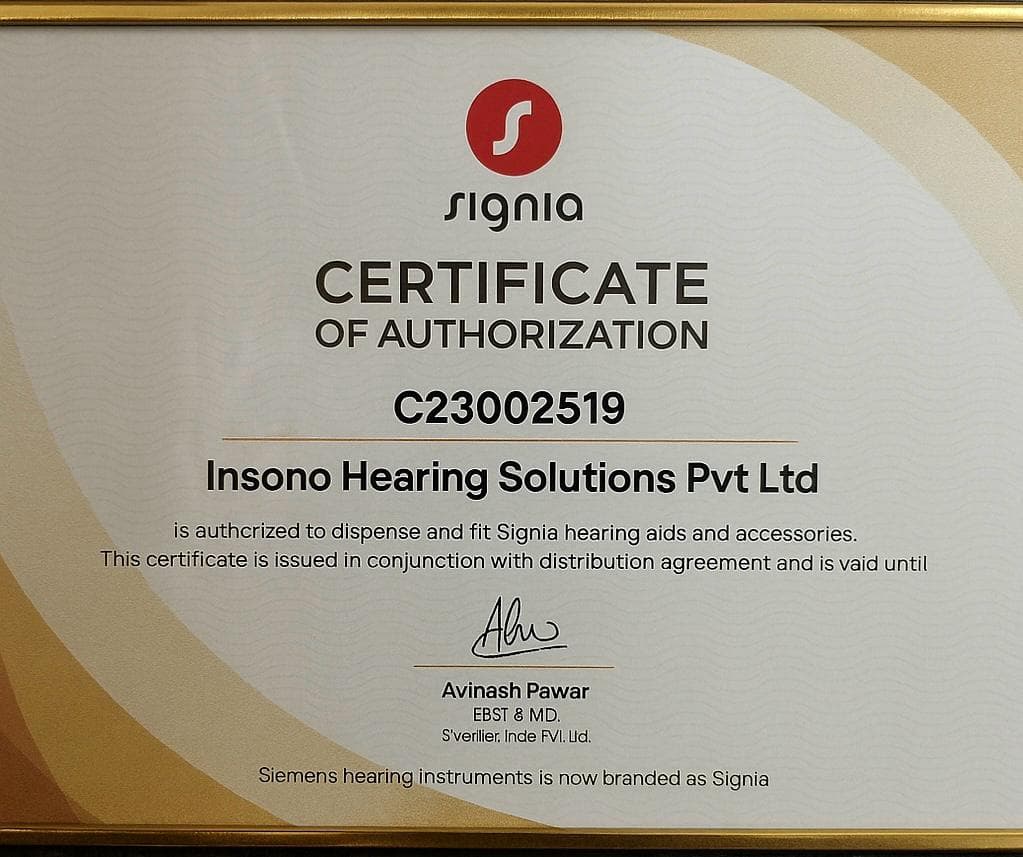
Official Certifications from Widex, Signia & Phonak
Insono Hearing Solutions is an authorized partner for leading global hearing aid brands including Widex, Signia, Phonak, and Oticon. These certifications reflect our trusted expertise and commitment to world-class hearing care in India.


Discover the Different Types of Hearing Aids for Better Hearing
Learn about the latest digital hearing aids, from behind-the-ear (BTE) to completely-in-canal (CIC) devices. Find the right style, features, and comfort level that suit your lifestyle.