Oticon
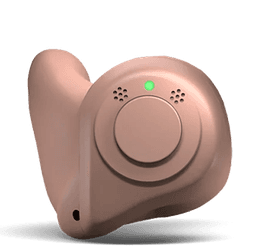
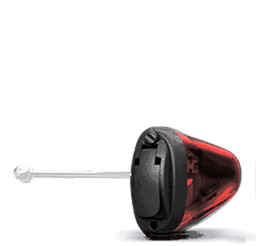
OTICON HIT POWER Completely-In-The-Canal (CIC) Hearing Aid
₹22,000MRP
Technology
AI-PoweredNoise CancellationTinnitus Masking
Style
CIC
Available Colors
BlackSilverDark ChampagneGreyBeigeBrown
Suitable For
Mild Hearing LossModerate Hearing LossSevere Hearing Loss
✅ Free 3-day home trial·🚚 Cash on delivery·🛡️ Genuine warranty
The Oticon HIT Power CIC Completely-In-The-Canal Hearing Aid is a compact, custom-made digital power hearing aid designed for adults who require stronger amplification while preferring a discreet in-the-ear hearing solution. As part of the Oticon HIT hearing-aid family, the HIT Power CIC combines digital signal processing, multi-channel fitting and power-oriented amplification in a custom CIC design.
CIC stands for Completely-In-The-Canal, meaning that the hearing aid is manufactured to sit deeply within the ear canal, keeping most of the instrument concealed inside the ear. This makes the CIC format particularly attractive to users who place a high value on discretion but still require more amplification than a standard low-power CIC may provide.
The model-specific Indian hearing-aid catalogues list the Oticon HIT Power CIC as a 4 I 4 device with an approximate fitting range up to 100 dB HL, using a size-10 disposable battery and approximately 115 hours of calculated battery life.
The original HIT family documentation distinguishes the CIC/MIC Power version from the standard CIC/MIC and shows substantially higher acoustic output and gain for the Power configuration. The documented HIT family also includes technologies such as noise management, feedback management, Front Focus, wind-noise protection and AutoPhone in applicable configurations.
The HIT Power CIC is an older-generation digital hearing aid. It should therefore be presented accurately as a traditional digital power CIC rather than as a modern wireless or rechargeable hearing aid. Features such as Bluetooth, direct smartphone streaming, lithium-ion rechargeable batteries, artificial intelligence or newer-generation Oticon processing should not be attributed to this model without exact model-specific documentation.
What Is a Power CIC Hearing Aid?
A Power CIC is a Completely-In-The-Canal hearing aid designed to provide greater amplification than a conventional standard CIC configuration.
A normal CIC focuses heavily on compact size and discreet placement. A Power CIC uses a stronger amplification configuration while retaining the CIC form factor as much as practical.
This makes it relevant to users who want:
A discreet custom hearing aid
In-the-ear placement
Higher amplification capability
Digital sound processing
A custom-made shell
Traditional disposable-battery operation
A solution that is less visible than a conventional BTE
However, increasing amplification inside a small custom shell creates additional fitting considerations. Feedback management, shell fit, venting and acoustic coupling become particularly important.
The hearing professional should therefore determine whether a Power CIC is appropriate for the patient's audiogram and ear anatomy.
Key Features of Oticon HIT Power CIC
1. Completely-In-The-Canal Design
The HIT Power CIC is manufactured as a custom Completely-In-The-Canal hearing aid.
The device is positioned deep inside the ear canal, allowing the outer ear to conceal a substantial portion of the instrument.
This provides a discreet appearance compared with many conventional hearing-aid styles.
The actual visibility differs from person to person. Ear-canal dimensions, the amount of amplification required and the size of the internal electronics can all influence the final shell design.
For users who are concerned about wearing a visible hearing aid, the CIC format can be an attractive option.
2. Power-Oriented Amplification
The key distinction between the standard HIT CIC and the HIT Power CIC is the higher amplification capability of the Power configuration.
The Indian catalogue lists the standard HIT CIC with an approximate fitting range up to 80 dB HL, while the HIT Power CIC is listed up to approximately 100 dB HL.
This makes the Power CIC a substantially higher-output configuration within the HIT CIC family.
The higher-output design can be considered for patients whose hearing loss requires more amplification than the standard CIC can appropriately provide.
However, the catalogue fitting range is not a substitute for an individual hearing assessment. The patient's complete audiogram and speech understanding must be evaluated before selecting the device.
3. Digital Signal Processing
The HIT Power CIC is a digital hearing aid.
Digital processing allows the hearing instrument to analyse incoming sound and apply programmed amplification before delivering the processed signal to the ear.
This is important because hearing loss is generally frequency-specific.
For example, an individual may have:
Relatively mild low-frequency hearing loss
Greater mid-frequency hearing loss
Significant high-frequency hearing loss
Digital processing allows the hearing professional to make adjustments across different frequency regions rather than simply increasing every sound equally.
4. Four-Channel / Four-Band Configuration
The HIT Power CIC is listed with a 4 I 4 configuration, corresponding to four fitting channels/bands.
Four-channel processing provides the hearing-care professional with multiple frequency regions in which the amplification response can be adjusted.
This allows the fitting to be more individualized than a simple single-channel system.
The professional can adjust the device according to:
Hearing thresholds
Frequency-specific hearing loss
Speech audibility
Listening comfort
Patient preferences
The number of channels is only one part of hearing-aid performance. Correct programming and verification remain essential.
5. High Output and Gain
The original HIT technical documentation provides separate acoustic specifications for the CIC/MIC Power configuration. The Power configuration is documented with a higher maximum output and higher full-on gain than the standard CIC/MIC configuration.
The technical data lists the CIC/MIC Power configuration at approximately:
Peak OSPL90: 118 dB SPL
HF average OSPL90: 112 dB SPL
Peak full-on gain: 50 dB
HF average full-on gain: 45 dB
Frequency range: approximately 100–7300 Hz
These are laboratory technical measurements and should not be interpreted as the amount of gain that every patient will receive in actual use. The hearing aid should be professionally programmed to the patient's hearing requirements.
6. Approximate Fitting Range Up to 100 dB HL
The available Indian product catalogues list the HIT Power CIC with an approximate fitting range up to 100 dB HL.
This is an important distinction between the standard HIT CIC and the Power CIC.
However, hearing-loss severity should never be assessed from a single number.
A hearing professional should evaluate:
Air-conduction thresholds
Bone-conduction thresholds
Speech recognition
Word recognition where appropriate
Frequency-specific requirements
Required gain
Maximum comfortable levels
Feedback risk
Ear anatomy
A Power CIC may be appropriate for some users within this general range, while another patient may require a different hearing-aid style.
7. Dynamic Feedback Cancellation 2
Higher-power hearing aids require careful feedback management because greater amplification can increase the possibility of acoustic feedback.
The HIT family incorporates Dynamic Feedback Cancellation 2 (DFC2).
Feedback occurs when amplified sound leaks from the ear and returns to the hearing-aid microphone, creating a loop that can result in whistling.
The risk can be influenced by:
Hearing-aid fit
Ear anatomy
Vent size
Shell design
Required gain
Earwax
Movement of the hearing aid
DFC2 is designed to help control acoustic feedback while maintaining useful amplification.
However, feedback-management technology does not replace an appropriately manufactured and fitted custom shell.
8. Directional Processing
Directional processing is part of the documented HIT platform.
In many everyday listening situations, the wearer needs to focus on one important sound source while competing sounds are present elsewhere.
For example, during a face-to-face conversation, the person speaking may be directly in front of the listener.
Directional processing can adjust the hearing-aid response to give greater emphasis to sounds arriving from the preferred direction in suitable environments.
This may help the wearer concentrate on a conversation.
Directional technology should not be described as complete background-noise elimination.
9. Noise Management
The HIT family incorporates noise-management technology.
Background noise can make speech understanding difficult, especially for individuals with hearing loss.
Examples of unwanted environmental sound include:
Traffic
Fans
Air conditioning
Restaurant activity
Household appliances
Crowds
Multiple conversations
Outdoor environmental noise
Noise-management processing is intended to improve listening comfort when unwanted sound is present.
The actual result depends on the listening environment, hearing loss, fitting and individual auditory ability.
10. Front Focus
Front Focus is a documented HIT-family feature designed to provide a listening configuration that emphasizes sounds from the front.
This can be useful when the wearer wants to concentrate on a speaker positioned in front of them.
For example, during a conversation in a moderately noisy environment, the wearer may use a forward-focused listening setting to concentrate on the person they are facing.
The function is designed to support listening rather than completely eliminate surrounding sounds.
11. Wind-Noise Protection
Wind can produce unwanted microphone noise, particularly when the wearer is outdoors.
The HIT platform incorporates wind-noise protection designed to help manage wind-related microphone interference.
This can be useful for users who regularly:
Walk outdoors
Travel
Spend time in open areas
Sit near open windows
Participate in outdoor activities
Reducing unwanted wind noise can make outdoor listening more comfortable.
12. Open-Ear Acoustic Approach
The HIT platform incorporates open-ear acoustic concepts in appropriate configurations.
The objective is to maintain a natural relationship between environmental sound and amplified sound.
With a Power CIC, the acoustic configuration is particularly important because higher amplification requires appropriate acoustic control.
The actual result depends on:
Shell design
Venting
Ear anatomy
Hearing loss
Required gain
Feedback requirements
Therefore, the final acoustic characteristics should be determined during professional fitting.
13. AutoPhone
The HIT platform includes AutoPhone functionality in applicable configurations.
Telephone conversations can be difficult for people with hearing loss because visual communication cues are unavailable.
AutoPhone is intended to help the hearing aid respond appropriately when a conventional telephone is placed near the hearing instrument.
This can make telephone listening more convenient for users who frequently communicate by phone.
The exact functionality should be confirmed for the individual Power CIC configuration.
14. Telecoil Functionality in Supported Configurations
Telecoil technology is documented within the broader HIT family.
A telecoil can receive compatible signals from induction-loop systems.
Loop systems may be found in certain:
Theatres
Cinemas
Public halls
Meeting rooms
Auditoriums
Places of worship
Other public venues
Telecoil availability should be confirmed for the exact HIT Power CIC configuration before presenting it as a guaranteed feature.
15. FM and DAI Compatibility
The broader HIT family documentation also identifies compatibility with selected FM/DAI solutions in supported configurations.
These technologies can allow audio from compatible external systems to be delivered to the hearing instrument.
They have traditionally been useful in:
Educational environments
Professional settings
Specialised communication situations
Accessory compatibility should always be verified against the exact device configuration.
Technical Specifications
Specification OTICON HIT POWER CIC
Brand Oticon
Product Family HIT
Model HIT Power CIC
Hearing Aid Style Completely-In-The-Canal
Technology Digital
Configuration Power CIC/MIC
Channels / Bands 4 I 4
Approx. Fitting Range Up to 100 dB HL
Battery Size 10 disposable
Approx. Catalogue Battery Life 115 hours
Peak OSPL90 Approx. 118 dB SPL
HF Average OSPL90 Approx. 112 dB SPL
Peak Full-On Gain Approx. 50 dB
HF Average Full-On Gain Approx. 45 dB
Frequency Range Approx. 100–7300 Hz in documented technical measurement
Feedback Technology Dynamic Feedback Cancellation 2
Directionality Supported in applicable HIT configurations
Noise Management Supported within HIT platform
Front Focus Supported within HIT platform
Wind-Noise Protection Supported within HIT platform
AutoPhone Supported in applicable configurations
Telecoil Configuration-dependent
FM/DAI Supported in applicable configurations
Bluetooth Not documented for HIT Power CIC
Rechargeable Battery No
Direct Smartphone Streaming Not documented
AI/DNN Processing Not a documented HIT Power CIC feature
The 100 dB HL fitting range and 10/115 battery specification are listed in Indian catalogues, while the acoustic output/gain figures are from documented Oticon technical data for the CIC/MIC Power configuration.
Battery and Battery Life
The HIT Power CIC uses a size-10 disposable zinc-air battery.
The available Indian catalogue lists approximately 115 hours of calculated battery life for the HIT Power CIC.
Battery performance can vary according to:
Daily wearing time
Degree of hearing loss
Amount of amplification
Environmental sound
Device settings
Battery quality
Individual usage
Therefore, the catalogue figure should be treated as an approximate reference rather than a guaranteed duration.
Users should keep spare size-10 batteries available, especially when travelling.
Batteries should be stored safely and kept away from children and pets.
Discreet Cosmetic Appearance
One of the most important advantages of the Power CIC format is its discreet appearance.
The device is positioned inside the ear canal, which allows the outer ear to conceal much of the instrument.
This can be particularly attractive for people who are reluctant to wear a visible hearing aid.
However, the term Completely-In-The-Canal does not mean that the hearing aid is guaranteed to be completely invisible.
Visibility depends on:
Ear-canal depth
Ear size
Shell design
Hearing-loss requirements
Internal components
A hearing professional can provide a realistic expectation after examining the patient's ear.
Power CIC and Higher Hearing Loss
The Power CIC is particularly notable because it combines a discreet CIC format with higher amplification capability.
The catalogue lists the standard HIT CIC up to approximately 80 dB HL and the Power CIC up to approximately 100 dB HL.
This makes the Power CIC relevant when a patient needs more amplification but still wants an in-ear form factor.
However, a higher fitting range does not automatically mean that a Power CIC is the best option for every person with severe hearing loss.
A power BTE may be preferable when the patient requires:
Very high output
Greater physical space
Easier handling
Larger battery
More robust controls
Greater flexibility in acoustic coupling
The audiologist should make the final recommendation based on the patient's audiogram.
Speech Understanding
The main purpose of the HIT Power CIC is to provide appropriate amplification for hearing loss and support everyday communication.
The hearing aid can increase access to speech information that has become difficult to hear because of hearing loss.
The four-channel fitting structure allows the professional to adjust amplification across multiple frequency regions.
Directional and noise-management functions can provide additional support when competing sound is present.
However, hearing aids do not restore normal hearing.
Speech understanding can still be affected by:
Severe background noise
Multiple simultaneous speakers
Distance from the speaker
Poor room acoustics
Degree of hearing loss
Reduced speech discrimination
Realistic expectations are essential.
Listening in Quiet Environments
The Power CIC can provide programmed amplification for everyday communication in relatively quiet environments.
Examples include:
Conversations with family
One-to-one conversations
Home communication
Watching television
Speaking with doctors
Conversations with colleagues
Quiet social situations
The audiologist can adjust the hearing aid if the patient experiences excessive loudness or insufficient audibility.
Listening in Noise
Noisy environments are more challenging for most hearing-aid users.
The HIT Power CIC's directional and noise-management technologies are intended to support listening in appropriate noisy situations.
Users can improve performance by combining technology with communication strategies.
For example:
Face the speaker.
Move closer to the person speaking.
Sit away from loudspeakers.
Choose quieter seating.
Reduce unnecessary background noise.
Ask people to speak clearly.
Avoid conversations directly beside loud machinery.
These strategies can be particularly valuable for users with significant hearing loss.
Telephone Communication
The HIT platform's AutoPhone feature can support conventional telephone use in applicable configurations.
Telephone conversations remove visual information, making them more difficult for many hearing-aid users.
Correct telephone positioning should be demonstrated by the hearing professional.
The user should not assume that the telephone must be held directly against the hearing aid.
The best position depends on the hearing aid and individual ear anatomy.
Custom Shell and Physical Fit
The Power CIC requires careful custom fitting.
Higher amplification makes acoustic sealing and feedback management particularly important.
The shell should:
Sit securely
Remain comfortable
Provide appropriate acoustic coupling
Avoid unnecessary pressure
Allow convenient insertion and removal
If the device causes pain, persistent pressure or frequent feedback, the user should return to the hearing-care professional.
The shell may require modification or refitting.
Professional Fitting Procedure
A typical fitting process includes:
Step 1: Hearing Assessment
The audiologist measures hearing thresholds across relevant frequencies.
Step 2: Speech Assessment
Speech recognition may be assessed where appropriate.
Step 3: Ear Examination
The ear is examined to ensure that a CIC fitting is appropriate.
Step 4: Ear Impression
A physical impression may be taken for custom manufacturing.
Step 5: Device Selection
The professional confirms whether standard CIC or Power CIC is appropriate.
Step 6: Programming
The hearing aid is programmed according to the audiogram and prescribed fitting targets.
Step 7: Verification
The professional checks the amplification and output.
Step 8: Physical Fit
Comfort and retention are evaluated.
Step 9: Patient Training
The user is taught insertion, removal, battery replacement and cleaning.
Step 10: Follow-Up
The hearing aid can be fine-tuned after the patient has used it in real-life situations.
Adaptation to Power Amplification
A person who has been living with significant hearing loss may have become accustomed to reduced sound levels.
When a Power CIC is fitted appropriately, environmental sounds can initially seem much more noticeable.
The wearer may suddenly hear:
Footsteps
Clothing movement
Fans
Utensils
Traffic
Paper
Household appliances
Background conversations
This can be part of the adjustment process.
The hearing professional may initially program the hearing aid conservatively and gradually adjust amplification as the user becomes comfortable.
The exact adaptation strategy depends on the patient.
Feedback Management and Power Hearing
Feedback is an especially important consideration with power hearing aids.
Because the HIT Power CIC can provide higher amplification, the hearing professional must carefully balance:
Required gain
Shell fit
Venting
Feedback margin
Comfort
Sound quality
The HIT platform's Dynamic Feedback Cancellation 2 provides electronic feedback management, but physical fit remains critical.
A patient should not simply increase volume if speech is difficult to hear. Persistent problems should be evaluated professionally.
Who May Consider the Oticon HIT Power CIC?
The HIT Power CIC may be considered by adults who:
Require more amplification than a standard CIC may provide.
Prefer a discreet in-ear hearing aid.
Have hearing loss within the appropriate fitting range.
Want a custom-made hearing solution.
Prefer disposable-battery operation.
Have suitable ear anatomy for a CIC.
Participate in regular face-to-face communication.
Prefer an in-ear device over a conventional BTE.
Do not specifically require modern Bluetooth connectivity.
The final selection should always be based on professional hearing assessment.
Who May Need a Power BTE Instead?
A Power CIC is not necessarily appropriate for every person with severe hearing loss.
A Power BTE may be considered when the patient requires:
Higher output
Greater gain
Larger battery capacity
Easier manual handling
More space for controls
Greater flexibility in earmould selection
Additional power for substantial hearing loss
The choice between Power CIC and Power BTE should be based on the patient's audiogram, anatomy, lifestyle and handling ability.
HIT Power CIC vs Standard HIT CIC
Feature HIT CIC HIT Power CIC
Style CIC Power CIC
Channels/Bands 4 I 4 4 I 4
Approx. Fitting Range Up to 80 dB HL Up to 100 dB HL
Battery Size 10 Size 10
Approx. Catalogue Battery Life 115 hours 115 hours
Amplification Standard CIC Higher-power configuration
Main Benefit Discreet amplification Higher amplification in a CIC format
Recommended Selection Based on audiogram Based on audiogram
The catalogue specifications show the main distinction as the higher fitting range of the Power CIC.
HIT Power CIC vs HIT Power D BTE
The HIT family also includes the HIT Power D BTE, which provides substantially greater physical space and output capability.
The available Indian catalogue lists the HIT Power D BTE at approximately 105 dB HL, with a size-13 battery and approximately 215 hours of calculated battery life, compared with the Power CIC at approximately 100 dB HL and size-10/115 hours.
The Power CIC therefore prioritizes discreet in-ear placement, while the Power BTE provides a larger behind-the-ear format.
The appropriate option depends on the patient's hearing requirements and preferences.
Care and Maintenance
Because the HIT Power CIC sits inside the ear canal, proper maintenance is particularly important.
Users should:
Keep the hearing aid dry.
Avoid water exposure.
Remove it before bathing or swimming.
Clean the hearing aid according to professional instructions.
Keep the sound outlet clear.
Monitor for earwax accumulation.
Replace batteries when required.
Store the hearing aid safely.
Avoid dropping the device.
Keep batteries away from children and pets.
Arrange professional cleaning when necessary.
Do not use sharp objects to clean the sound outlet or microphone openings.
Earwax and CIC Hearing Aids
Earwax can have a greater impact on custom in-ear hearing aids because the instrument is positioned close to the ear canal.
Excessive wax can:
Reduce sound output
Block the sound outlet
Increase feedback
Distort sound
Affect the fit
Patients should have excessive earwax professionally managed rather than attempting deep ear cleaning themselves.
Regular hearing-aid cleaning and ear-health checks can help maintain reliable performance.
Common Problems
Whistling
Persistent whistling may indicate:
Poor shell fit
Wax accumulation
Excessive gain
Venting issues
Movement of the device
The device should be professionally checked.
Weak Sound
Possible causes include:
Low battery
Blocked sound outlet
Wax
Electronic fault
Distorted Sound
Professional cleaning and inspection may be required.
Physical Discomfort
The shell may need adjustment if the user experiences persistent pressure or irritation.
Difficulty Inserting the Device
The patient should receive hands-on instruction rather than forcing the device into the ear.
Important Information About Modern Features
The Oticon HIT Power CIC is an older-generation hearing aid.
It should not be confused with current Oticon CIC products.
For example, current Oticon products such as Oticon Own and other newer product families have technology platforms and connectivity options that were not part of the original HIT Power CIC. Current Oticon product pages should therefore not be used to assign those features to the older HIT model.
For accurate product marketing, the HIT Power CIC should not be described as having:
Bluetooth
Direct smartphone streaming
Rechargeable lithium-ion battery
Artificial intelligence
Deep Neural Network processing
Modern BrainHearing technology
Current-generation wireless accessories
unless exact documentation for a particular unit confirms the feature.
Realistic Patient Expectations
The HIT Power CIC is designed to provide stronger amplification while maintaining a discreet CIC form factor.
However, no hearing aid can reproduce normal hearing.
Patients may still experience difficulty in:
Very noisy restaurants
Large family gatherings
Crowded markets
Multiple-speaker situations
Reverberant rooms
Very distant conversations
A hearing aid is one part of successful hearing rehabilitation.
Communication strategies, realistic expectations and consistent hearing-aid use are equally important.
Patient Education
Before receiving the device, the patient should understand:
How to insert the CIC
How to remove it
How to change the size-10 battery
How to identify a low battery
How to clean the sound outlet
How to protect the device from moisture
How to use the telephone
When to return for fine-tuning
What to do if feedback occurs
Good education can significantly improve confidence and satisfaction.
Frequently Asked Questions
What is the Oticon HIT Power CIC?
It is a custom-made, completely-in-the-canal digital power hearing aid from the Oticon HIT family.
What does Power CIC mean?
Power CIC indicates a higher-output CIC configuration designed to provide more amplification than the standard CIC version.
How many channels does it have?
The available catalogue specification lists 4 I 4, corresponding to four fitting channels/bands.
What is the fitting range?
The Indian catalogue lists the HIT Power CIC with an approximate fitting range of up to 100 dB HL.
Which battery does it use?
It uses a size-10 disposable hearing-aid battery.
How long does the battery last?
The catalogue lists approximately 115 hours of calculated battery life. Actual battery duration varies with hearing-aid settings and usage.
Is the HIT Power CIC rechargeable?
No. The documented configuration uses a disposable size-10 battery.
Does it have Bluetooth?
Bluetooth is not documented for the HIT Power CIC and should not be advertised as a feature of this model.
Can it connect directly to a smartphone?
Direct smartphone streaming is not documented for the HIT Power CIC.
Is it invisible?
It is designed to be highly discreet, but it is not guaranteed to be completely invisible. Visibility depends on the user's ear anatomy and required device configuration.
Is it suitable for severe hearing loss?
It has a higher-power configuration and is listed with an approximate fitting range up to 100 dB HL. However, suitability for an individual with severe hearing loss must be determined from the complete audiogram and professional fitting assessment.
Can it be fitted in both ears?
Yes, where clinically appropriate, the device can be considered for bilateral fitting. The decision depends on the patient's hearing assessment and communication needs.
Final Professional Summary
The Oticon HIT Power Completely-In-The-Canal (CIC) Hearing Aid is a compact custom digital power hearing aid designed for adults who require greater amplification while preferring a discreet in-ear hearing solution.
Its documented model-specific specifications include 4-channel/4-band processing, an approximate fitting range up to 100 dB HL, a size-10 disposable battery and approximately 115 hours of calculated battery life.
The technical documentation for the HIT CIC/MIC Power configuration also records approximately 118 dB SPL peak OSPL90, 112 dB SPL HF-average OSPL90, 50 dB peak full-on gain, 45 dB HF-average full-on gain and a frequency range of approximately 100–7300 Hz under laboratory measurement conditions. These technical values describe the instrument's electroacoustic capability and should not be interpreted as the recommended gain for every patient.
The HIT Power CIC incorporates established HIT-family technologies including digital processing, multi-channel fitting, directional processing, noise management and Dynamic Feedback Cancellation 2. Front Focus, wind-noise protection and AutoPhone are also documented within the HIT platform, while telecoil and FM/DAI functions should be treated as configuration-dependent.
Its principal advantage is the combination of higher amplification capability with a discreet CIC form factor. This makes it potentially relevant to adults who need more amplification than a standard CIC can provide but prefer not to use a conventional behind-the-ear hearing aid.
The HIT Power CIC is, however, an older-generation hearing instrument. It should not be marketed with modern Bluetooth, rechargeable, smartphone-streaming or AI features unless the exact device documentation confirms them.
Ultimately, successful hearing-aid use depends on more than the device itself. Accurate audiological assessment, appropriate model selection, precise programming, comfortable physical fitting, realistic expectations, consistent use and professional follow-up all contribute to the patient's hearing experience.
For an adult whose hearing profile falls within the appropriate fitting range and who values both higher amplification and a discreet custom in-ear design, the Oticon HIT Power CIC represents a practical power-CIC solution from Oticon's earlier generation of digital hearing technology.
More Oticon Hearing Aids
OTICON GO PRO D VC / GO PRO D Behind-The-Ear (BTE) Hearing Aid
OTICON GO PRO POWER D Behind-The-Ear (BTE) Hearing Aid
OTICON GO PRO D In-The-Canal (ITC) Hearing Aid
OTICON GO PRO In-The-Canal (ITC) Hearing Aid
OTICON GO PRO PB Completely-In-Canal (CIC) Hearing Aid
OTICON GO PRO PB POWER Behind-The-Ear (BTE) Hearing Aid
OTICON GO PRO D VC / GO PRO D Behind-The-Ear (BTE) Hearing Aid
OTICON GO PRO POWER D Behind-The-Ear (BTE) Hearing Aid
OTICON GO PRO D In-The-Canal (ITC) Hearing Aid
OTICON GO PRO In-The-Canal (ITC) Hearing Aid
OTICON GO PRO PB Completely-In-Canal (CIC) Hearing Aid
OTICON GO PRO PB POWER Behind-The-Ear (BTE) Hearing Aid
Frequently Asked Questions
What is a Oticon hearing aid?▼
Oticon is a world-leading hearing aid brand known for its advanced technology, exceptional sound quality, and reliability. The OTICON HIT POWER Completely-In-The-Canal (CIC) Hearing Aid is one of their premium models designed to help people with hearing loss experience clear, natural sound.
What technology does the OTICON HIT POWER Completely-In-The-Canal (CIC) Hearing Aid use?▼
The OTICON HIT POWER Completely-In-The-Canal (CIC) Hearing Aid features AI-Powered, Noise Cancellation, Tinnitus Masking. These technologies work together to deliver outstanding clarity, comfort, and connectivity for the wearer.
What is the style and shape of the OTICON HIT POWER Completely-In-The-Canal (CIC) Hearing Aid ?▼
The OTICON HIT POWER Completely-In-The-Canal (CIC) Hearing Aid is available in CIC style(s). This makes it extremely discreet and nearly invisible when worn.
Is the OTICON HIT POWER Completely-In-The-Canal (CIC) Hearing Aid invisible or discreet?▼
Yes, the OTICON HIT POWER Completely-In-The-Canal (CIC) Hearing Aid is designed for maximum discretion. Its compact form factor sits deep in the ear canal or close to it, making it nearly invisible to others.
What level of hearing loss is the OTICON HIT POWER Completely-In-The-Canal (CIC) Hearing Aid suitable for?▼
The OTICON HIT POWER Completely-In-The-Canal (CIC) Hearing Aid is recommended for individuals with Mild Hearing Loss, Moderate Hearing Loss, Severe Hearing Loss. We advise getting a professional hearing assessment to confirm the best solution for your specific needs.
What is the price of the OTICON HIT POWER Completely-In-The-Canal (CIC) Hearing Aid ?▼
The OTICON HIT POWER Completely-In-The-Canal (CIC) Hearing Aid is priced at ₹22,000. Insono Hearing offers flexible EMI options and financing. Contact us for the latest offers and to schedule a free trial.
Where can I get a free trial of the OTICON HIT POWER Completely-In-The-Canal (CIC) Hearing Aid in India?▼
Insono Hearing offers free trials for the OTICON HIT POWER Completely-In-The-Canal (CIC) Hearing Aid at our clinics. Book an appointment online or call us to experience the device before making a decision.
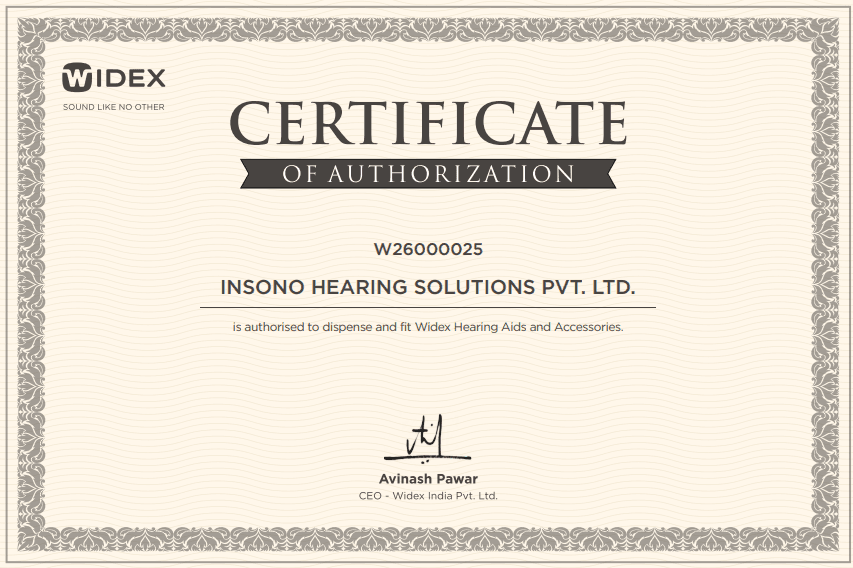
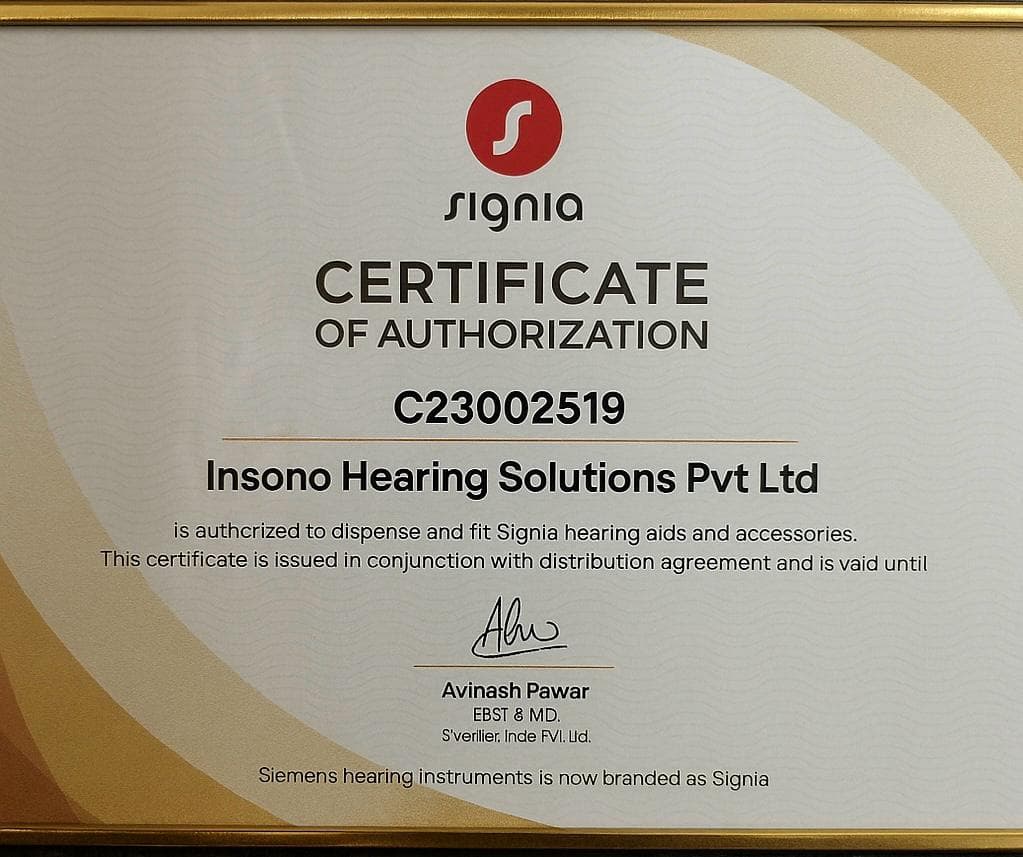
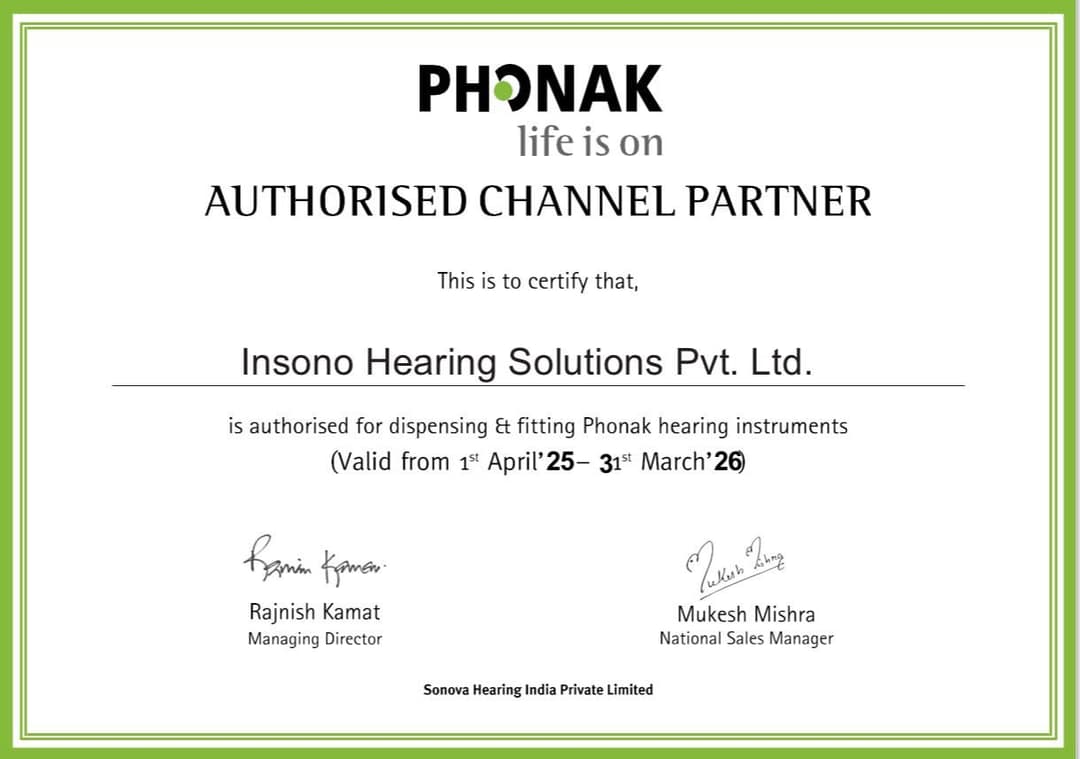
Official Certifications from Widex, Signia & Phonak
Insono Hearing Solutions is an authorized partner for leading global hearing aid brands including Widex, Signia, Phonak, and Oticon. These certifications reflect our trusted expertise and commitment to world-class hearing care in India.
Discover the Different Types of Hearing Aids for Better Hearing
Learn about the latest digital hearing aids, from behind-the-ear (BTE) to completely-in-canal (CIC) devices. Find the right style, features, and comfort level that suit your lifestyle.