Oticon
OTICON HIT D RITE Receiver-In-The-Ear (RIC) Hearing Aid
₹22,000MRP
Technology
Tinnitus MaskingNoise Cancellation
Style
ITE
Available Colors
BlackGreySilverDark ChampagneBeigeBrownPearl WhiteGraphiteBlack Gloss
Suitable For
Mild Hearing LossModerate Hearing LossSevere Hearing Loss
✅ Free 3-day home trial·🚚 Cash on delivery·🛡️ Genuine warranty
OTICON HIT D RITE RECEIVER-IN-THE-EAR (RITE/RIC) HEARING AID
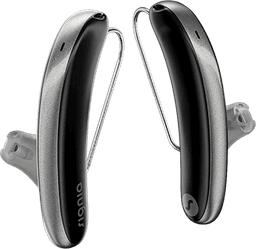
The Oticon HIT D RITE Receiver-In-The-Ear (RITE) Hearing Aid is a compact digital hearing solution designed for people with hearing loss who want a discreet behind-the-ear instrument combined with a receiver positioned close to the ear canal. The device belongs to the Oticon HIT family, an earlier generation of digital hearing technology developed to provide clear, comfortable and personalized amplification for everyday communication.
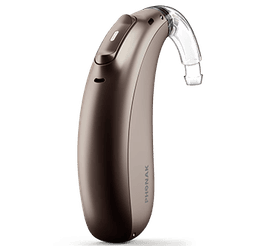
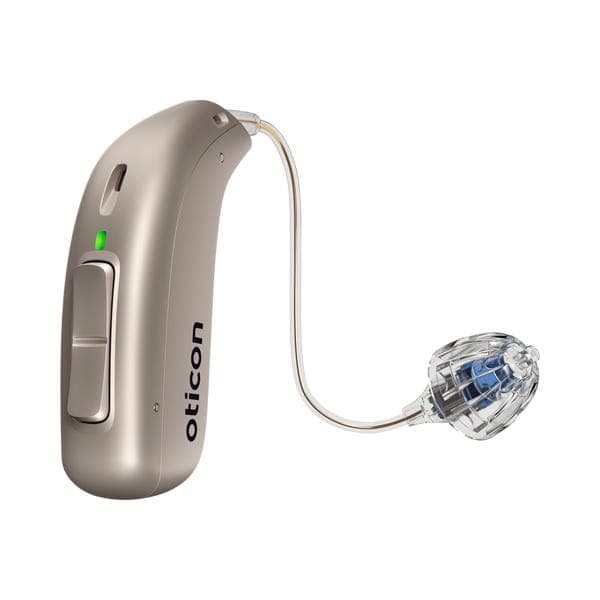
The HIT D RITE combines a small behind-the-ear housing with a thin receiver wire leading to the ear. Unlike a conventional BTE hearing aid, where amplified sound travels through tubing and an earmould or earhook, a RITE configuration places the receiver close to or inside the ear canal. This design can provide a compact appearance, natural acoustic characteristics and flexibility in fitting.
The Oticon HIT family was designed around fundamental hearing benefits including 8 kHz bandwidth, automatic directionality, noise management, feedback cancellation, open-ear acoustics and programmable digital processing. The HIT D RITE is listed with 4 fitting bands/channels, up to four user programs and a size-312 battery.
Available Indian product catalogues identify the HIT D RITE with a fitting range of approximately 80 dB HL, a 312 battery, and approximately 108 hours of typical battery life.
Because the HIT is an older Oticon generation, it should not be confused with current Oticon RITE or miniRITE products. Modern features such as Bluetooth Low Energy, direct smartphone streaming, rechargeable lithium-ion batteries, artificial intelligence or newer Oticon processing platforms should not be attributed to HIT D RITE unless separately confirmed for a specific configuration.
PRODUCT OVERVIEW
The Oticon HIT D RITE is intended for users who require amplification for hearing loss within the instrument's fitting capability and who prefer a discreet RITE design.
Its main components include:
A compact behind-the-ear hearing-aid housing
A thin receiver wire
A receiver positioned close to the ear canal
An ear tip or compatible custom earpiece
A size-312 disposable battery
Digital signal processing
Directional microphone technology
Noise-management processing
Feedback cancellation
Programmable hearing settings
The RITE concept separates the main processing unit from the receiver. The hearing aid's microphones and digital processing remain in the small housing behind the ear, while the receiver delivers amplified sound closer to the eardrum.
This configuration can offer a practical combination of discretion, comfort and acoustic performance.
KEY FEATURES OF OTICON HIT D RITE
1. Receiver-In-The-Ear Design
The defining feature of the HIT D RITE is its Receiver-In-The-Ear design.
The hearing aid housing sits behind the ear while the receiver is positioned near the ear canal. A thin electrical wire connects the receiver to the main hearing-aid unit.
This arrangement can make the device less visually prominent than some traditional BTE hearing aids.
The receiver placement also reduces the need for a conventional sound tube extending from the behind-the-ear housing into the ear.
For suitable hearing losses, RITE technology can provide a comfortable and discreet hearing solution.
2. Compact and Discreet Appearance
Oticon's HIT documentation describes the BTE and RITE styles as small and discreet, combining compact construction with user-friendly ergonomics.
The RITE architecture contributes to this discreet appearance because the receiver wire is thin and the receiver itself is positioned close to the ear canal.
This can be particularly attractive to adults who are concerned about the visibility of a hearing aid.
The actual visibility depends on:
Ear shape
Hair style
Receiver length
Dome or earmould selection
Skin and hearing-aid colour
Individual ear anatomy
A hearing-care professional should select the appropriate receiver length and earpiece for the user.
3. Digital Programmable Technology
The HIT D RITE is a programmable digital hearing aid.
Digital processing allows the hearing-care professional to adjust amplification according to the user's hearing test.
This is important because hearing loss can differ substantially between individuals.
For example, one user may have greater difficulty hearing high-frequency consonants, while another may have a broader or more evenly distributed hearing loss.
Programmable amplification allows the audiologist to create an individualized fitting rather than relying on a single fixed amplification curve.
4. Four Fitting Bands
The HIT D RITE is listed with four fitting bands.
Multiple fitting bands provide the audiologist with greater flexibility in adjusting amplification across different frequency regions.
This can help the professional tailor the hearing aid to the user's audiogram.
The number of bands should not be interpreted as a direct measurement of overall hearing-aid quality. It is one part of the fitting architecture, and the effectiveness of a hearing aid depends on its complete processing system, programming and individual fitting.
5. 8 kHz Bandwidth
The HIT family documentation identifies an 8 kHz bandwidth.
Bandwidth describes the range of frequencies over which the hearing aid can process and reproduce sound.
Access to higher-frequency information is relevant for speech sounds such as certain consonants and for environmental sounds.
A broader bandwidth can also contribute to the perception of sound detail.
However, the amount of high-frequency amplification appropriate for an individual depends on their hearing thresholds, comfort and speech understanding.
The audiologist should therefore determine the appropriate frequency response during fitting.
6. Automatic Directionality
The HIT platform incorporates Automatic Directionality.
Directional microphones are designed to make the hearing aid more sensitive to sounds arriving from selected directions while reducing the relative influence of sounds arriving from other directions.
This can be useful during face-to-face conversations.
For example, when a person is speaking in front of the wearer while there is competing noise elsewhere in the environment, directional processing can help emphasize the desired listening direction.
The HIT documentation identifies automatic directionality and dual-mode directional operation within the family.
Directionality does not eliminate background noise. It is one component of the overall hearing-aid processing strategy.
7. Noise Management
The Oticon HIT platform incorporates a modulation-based Noise Management System.
Noise management is designed to reduce the impact of interfering sounds while maintaining important speech information.
This can be useful in environments such as:
Restaurants
Family gatherings
Busy homes
Shopping areas
Outdoor environments
Offices
Public spaces
The objective is not to make the environment completely silent.
Instead, the hearing aid attempts to make competing noise less intrusive while preserving useful auditory information.
Individual results depend on the acoustic environment, degree of hearing loss and hearing-aid programming.
8. Dynamic Feedback Cancellation 2
The HIT family uses Dynamic Feedback Cancellation 2 (DFC2) as its feedback-management system.
Feedback is the high-pitched whistling or squealing sometimes produced by a hearing aid.
It occurs when amplified sound leaks from the ear and is picked up again by the hearing-aid microphone.
Feedback management is particularly important for RITE fittings because the receiver is positioned close to the ear canal.
DFC2 is designed to monitor and manage feedback so that the hearing aid can maintain stable amplification.
A proper physical fit is still essential. Feedback should not simply be assumed to be a software issue. Earwax, poor fit, damaged components or inappropriate programming can also contribute to feedback.
9. Open-Ear Acoustics
The HIT family includes Open Ear Acoustics among its documented features.
Open-ear fitting can allow some natural environmental sound to enter the ear without being completely occluded by a closed earmould.
This can be useful for suitable hearing losses, especially where the lower-frequency hearing is relatively good.
The RITE architecture can support an open fitting using an appropriate dome or earpiece.
However, not every hearing loss is suitable for an open fitting. Users with more significant low-frequency hearing loss may require a more closed coupling to achieve adequate amplification and prevent feedback.
10. Multiple User Programs
The HIT documentation lists four user programs for the HIT platform.
Programs allow the hearing-care professional to configure different listening settings for different environments.
Depending on the fitting, programs can be used for situations such as:
Everyday listening
Quiet conversation
Noisy environments
Specific listening situations
The exact program configuration should be determined by the audiologist.
The user should also be taught how to recognize program changes through the available sound indicators.
11. Automatic Adaptation Manager
The broader HIT family documentation lists an Automatic Adaptation Manager, although its availability differs between HIT and HIT Pro configurations.
Where supported by the specific configuration, adaptation technology is designed to help the wearer become accustomed to amplified sound.
This is particularly relevant for new hearing-aid users or individuals who have not worn hearing aids consistently in the past.
The adaptation process can involve gradually introducing more amplification until the prescribed target is reached.
The exact availability and behavior should therefore be confirmed for the specific HIT D RITE configuration.
12. NAL-NL1 and DSL v5.0a m[i/o] Fitting
Oticon's HIT documentation lists NAL-NL1 and DSL v5.0a m[i/o] among its fitting options.
Fitting formulas are important because they provide a structured method for calculating appropriate amplification based on hearing thresholds and other parameters.
The audiologist can select the most appropriate fitting approach based on the user's age, hearing loss, communication needs and clinical requirements.
The fitting formula is then fine-tuned based on the individual's subjective experience and objective verification where appropriate.
13. Front Focus
Front Focus is listed among the HIT family features.
The purpose of front-focused processing is to support listening when the primary sound source is located in front of the wearer.
This can be particularly relevant during conversations.
When a person sits directly across from another speaker, maintaining attention toward the front can help the hearing-aid system prioritize the relevant sound environment.
14. Wind Noise Protection
Wind can create considerable microphone noise, especially when walking outdoors or riding in an open vehicle.
The HIT family documentation lists wind noise protection among its features.
Wind-noise management is designed to make outdoor listening more comfortable by reducing the disruptive effects of wind reaching the microphones.
It does not mean that wind noise will disappear completely under all circumstances.
15. AutoPhone Program
The HIT product documentation lists an AutoPhone program.
This function is designed to support telephone listening.
Telephone communication can be difficult for people with hearing loss because the acoustic signal is concentrated near one ear while visual speech cues are unavailable.
Where supported and appropriately configured, AutoPhone can help transition the hearing aid into an appropriate telephone listening setting.
The exact operation depends on the phone, hearing-aid configuration and fitting.
16. Telecoil
Telecoil functionality is documented within the HIT family.
A telecoil can receive signals from compatible hearing-loop systems.
This can be useful in locations equipped with induction loops, including certain:
Theatres
Auditoriums
Meeting halls
Places of worship
Public venues
The availability of telecoil should always be verified for the exact device configuration being supplied.
17. FM Compatibility
The HIT family documentation also identifies FM compatibility for the RITE/BTE platform.
FM systems can be useful in environments where a remote microphone or transmitter sends sound directly to a compatible receiver.
This type of technology has historically been used in educational and other communication environments.
Compatibility depends on the appropriate accessories and exact device configuration.
18. DAI Compatibility
The HIT documentation identifies DAI among its accessories and connectivity options.
DAI, or Direct Audio Input, is a traditional method of connecting compatible external audio equipment directly to a hearing instrument.
This should not be confused with modern wireless Bluetooth connectivity.
19. Battery Low Warning
The HIT platform includes a battery-low warning.
This helps the wearer recognize when the battery is approaching the end of its usable life.
A user should carry spare batteries when appropriate, particularly during travel or important events.
20. Sound Indicators
The HIT documentation lists sound indicators for programme shifts.
These audible indicators can help the wearer recognize that the hearing aid has changed programs or entered another operating mode.
This is useful for users who want confirmation that a control has been activated.
RECEIVER OPTIONS AND EARPIECES
The HIT RITE documentation describes several receiver and earpiece possibilities.
The receiver is available in different lengths, including:
Short
Medium
Long
Extra Long
This allows the hearing-care professional to select a receiver that follows the natural contour of the wearer's ear.
The documented earpiece options include:
Open Dome
Plus Dome
Power Dome
Micro Mould
Open domes are available in different sizes, while power domes provide a more closed coupling for users requiring greater acoustic control. The micro mould option requires an ear impression.
The appropriate coupling should be selected according to hearing loss, ear anatomy, required gain and feedback behavior.
MICRO MOULD OPTION
A micro mould provides a more custom connection between the receiver and the ear.
Compared with an open dome, a custom micro mould can provide a more secure and controlled fit.
This may be useful when:
Greater acoustic sealing is required
The wearer needs a more secure earpiece
An open fitting is not sufficient
Feedback needs additional physical control
The audiologist requires a custom coupling
The HIT documentation specifies wax protection for the micro mould through a WaxStop system.
BATTERY AND POWER
The Oticon HIT D RITE uses a size-312 disposable battery. Available Indian catalogues list approximately 108 hours of typical battery life for HIT D RITE.
Actual battery performance can vary considerably.
Factors affecting battery life include:
Daily wearing time
Hearing loss
Amplification level
Listening environment
Active processing functions
Battery quality
Use of accessories
Individual programming
Therefore, the stated battery life should be regarded as a typical reference rather than a guarantee.
TECHNICAL SPECIFICATIONS
Specification Oticon HIT D RITE
Brand Oticon
Product Family HIT
Model HIT D RITE
Style Receiver-In-The-Ear (RITE)
Technology Digital programmable
Fitting Bands 4
Bandwidth Up to 8 kHz
Approx. Fitting Range Up to 80 dB HL
Battery Size 312
Typical Battery Life Approximately 108 hours
Directionality Automatic Directionality
Noise Management Yes
Feedback Management Dynamic Feedback Cancellation 2 (DFC2)
Open Ear Acoustics Yes
User Programs Up to 4
Front Focus Yes
Wind Noise Protection Yes
AutoPhone Listed in HIT documentation
Telecoil Available within documented configurations
FM Compatible within documented configurations
DAI Available within documented configurations
Fitting Formulas NAL-NL1 and DSL v5.0a m[i/o]
Receiver Lengths Short, Medium, Long, Extra Long
Earpieces Open Dome, Plus Dome, Power Dome, Micro Mould
Rechargeable No; size-312 disposable battery
Bluetooth Not to be assumed
Smartphone Streaming Not to be assumed
The fitting range and battery information are corroborated by available Indian catalogues, while the broader technical feature set comes from Oticon's HIT product documentation.
WHO MAY CONSIDER OTICON HIT D RITE?
The Oticon HIT D RITE may be considered for adults who:
Have hearing loss within the instrument's fitting range
Prefer a discreet behind-the-ear hearing aid
Want a receiver-in-the-ear design
Prefer an open or semi-open fitting where clinically appropriate
Want programmable digital amplification
Need support for everyday conversations
Spend time in both quiet and moderately noisy environments
Prefer replaceable batteries
Want physical hearing-aid controls rather than relying on smartphone applications
May benefit from directional processing and noise management
The device should be selected after a hearing assessment.
SPEECH UNDERSTANDING AND EVERYDAY COMMUNICATION
The main objective of a hearing aid is to make important sounds more accessible.
For people with hearing loss, speech can become difficult to understand because certain frequencies or speech cues are less audible.
The HIT D RITE provides programmable amplification and processing designed to improve access to speech and environmental sounds.
Its directional processing can be useful when a speaker is in front of the wearer.
Noise management can help reduce the impact of fluctuating background noise.
Feedback cancellation helps maintain stable amplification.
The combination of these functions is designed to provide a more manageable listening experience across everyday environments.
However, hearing aids cannot guarantee perfect speech recognition in every situation.
Speech understanding also depends on:
Degree of hearing loss
Type of hearing loss
Speech discrimination ability
Listening distance
Background noise
Room acoustics
Speaker clarity
Hearing-aid programming
Consistency of hearing-aid use
FITTING AND PROFESSIONAL PROGRAMMING
Professional fitting is an essential part of using the Oticon HIT D RITE successfully.
The audiologist should:
Perform a complete hearing assessment.
Review the audiogram.
Determine whether RITE is appropriate.
Select the correct receiver strength and length.
Choose the appropriate dome or custom mould.
Program the hearing aid.
Adjust gain according to hearing thresholds.
Check for feedback.
Verify comfort.
Configure listening programs.
Explain battery replacement.
Explain cleaning and maintenance.
Schedule follow-up appointments.
A hearing aid should never be selected purely because a catalogue lists a particular maximum fitting range.
The patient's actual audiogram and listening needs are more important than the maximum specification.
COMFORT AND ADAPTATION
A first-time hearing-aid wearer may initially notice sounds that were previously difficult to hear.
For example, everyday sounds such as:
Footsteps
Paper movement
Cutlery
Fans
Water
Clothing movement
Traffic
Household appliances
may become more noticeable.
This does not necessarily mean the hearing aid is too loud.
The brain may simply need time to adapt to the increased access to sound.
The hearing professional can adjust the amplification if sounds remain uncomfortable.
CARE AND MAINTENANCE
Proper maintenance is essential for reliable performance.
Users should:
Keep the hearing aid dry.
Avoid exposing it to excessive moisture.
Remove it before swimming or bathing.
Clean the earpiece regularly.
Check the receiver for wax accumulation.
Replace the wax protection system when required.
Keep microphone openings clean.
Replace the battery when necessary.
Store the hearing aid safely when not in use.
Avoid dropping or striking the device.
Arrange periodic professional servicing.
The receiver is an important component and should be handled carefully when changing domes or cleaning the device.
EARWAX MANAGEMENT
Earwax can significantly affect RITE hearing-aid performance.
Excessive wax can:
Reduce sound output
Cause feedback
Block the receiver
Distort sound
Reduce perceived loudness
Increase the need for cleaning
Users should not push objects into the ear canal or receiver opening to remove wax.
Professional ear examination and appropriate wax management are recommended when excessive wax is suspected.
IS OTICON HIT D RITE RECHARGEABLE?
No modern rechargeable lithium-ion system should be assumed for this model.
The documented HIT D RITE uses a size-312 disposable battery, with approximately 108 hours of typical battery life listed in available product catalogues.
Users should therefore plan for regular battery replacement.
DOES IT HAVE BLUETOOTH?
The Oticon HIT D RITE should not be marketed as a modern Bluetooth hearing aid unless documentation for the exact unit specifically confirms wireless connectivity.
The HIT documentation describes technologies such as DAI, FM and telecoil, which are different from modern Bluetooth smartphone streaming.
This distinction is important when preparing accurate website or product-listing content.
HIT D RITE VERSUS MODERN RITE HEARING AIDS
The HIT D RITE represents an earlier generation of Oticon RITE technology.
Its documented strengths include:
Compact RITE architecture
8 kHz bandwidth
Automatic directionality
Noise management
DFC2 feedback cancellation
Four fitting bands
Multiple programs
Open-ear fitting options
Traditional telecoil/DAI/FM compatibility in supported configurations
Modern RITE hearing aids may offer additional technologies such as rechargeable batteries, Bluetooth connectivity, direct streaming, app control and newer signal-processing platforms.
These newer features should not be transferred to the HIT D RITE description without model-specific confirmation.
ADVANTAGES OF OTICON HIT D RITE
The key practical advantages include:
Discreet RITE design
Receiver positioned close to the ear canal
Digital programmable amplification
4 fitting bands
8 kHz bandwidth
Automatic directionality
Noise-management processing
Dynamic Feedback Cancellation 2
Open-ear acoustic options
Up to four user programs
Wind-noise protection
Front Focus
AutoPhone support within documented configurations
Telecoil compatibility within supported configurations
FM/DAI options within supported configurations
Multiple receiver lengths
Multiple earpiece choices
Size-312 replaceable battery
LIMITATIONS AND IMPORTANT CONSIDERATIONS
The HIT D RITE is an older-generation hearing instrument, so users looking specifically for modern wireless or rechargeable features should compare it with newer models.
It is also important to understand that a fitting range of approximately 80 dB HL does not mean the hearing aid is automatically suitable for every person with hearing loss below that threshold.
The audiologist should consider the complete audiogram and speech understanding.
For more severe hearing losses, a power BTE may provide a more appropriate solution.
For very mild losses, a smaller and more open fitting may be considered.
The correct choice depends on the individual.
FINAL OVERVIEW
The Oticon HIT D RITE Receiver-In-The-Ear Hearing Aid is a compact digital hearing solution designed around the RITE concept, placing the receiver close to the ear canal while keeping the main hearing-aid electronics behind the ear.
The model combines a discreet physical design with documented Oticon HIT technologies including 8 kHz bandwidth, four fitting bands, automatic directionality, noise management, Dynamic Feedback Cancellation 2, open-ear acoustics, wind-noise protection, Front Focus and multiple user programs.
Available Indian product information lists the HIT D RITE with an approximate 80 dB HL fitting range and size-312 battery with around 108 hours of typical battery life.
Its receiver-in-the-ear construction can provide a discreet appearance and flexible fitting options through different receiver lengths, domes and custom micro moulds. This makes the model particularly relevant for users who want an in-ear receiver arrangement rather than a traditional BTE sound tube.
The device is best understood as a traditional digital RITE hearing aid from the Oticon HIT generation. It should not be described using specifications from newer Oticon product families, particularly modern Bluetooth, rechargeable, artificial-intelligence or newer-generation signal-processing claims unless those capabilities are independently confirmed for the exact device.
Ultimately, successful hearing-aid use depends on more than the hardware itself. A comprehensive hearing assessment, appropriate receiver and earpiece selection, accurate programming, feedback verification, user education and follow-up adjustments are essential.
For an individual whose hearing loss falls within the documented fitting capability and who prefers a compact RITE design with established digital processing, directional technology, noise management and feedback control, the Oticon HIT D RITE provides a practical hearing-aid option from the Oticon HIT family.
More Oticon Hearing Aids
OTICON GO PRO D VC / GO PRO D Behind-The-Ear (BTE) Hearing Aid
OTICON GO PRO POWER D Behind-The-Ear (BTE) Hearing Aid
OTICON GO PRO D In-The-Canal (ITC) Hearing Aid
OTICON GO PRO In-The-Canal (ITC) Hearing Aid
OTICON GO PRO PB Completely-In-Canal (CIC) Hearing Aid
OTICON GO PRO PB POWER Behind-The-Ear (BTE) Hearing Aid
OTICON GO PRO D VC / GO PRO D Behind-The-Ear (BTE) Hearing Aid
OTICON GO PRO POWER D Behind-The-Ear (BTE) Hearing Aid
OTICON GO PRO D In-The-Canal (ITC) Hearing Aid
OTICON GO PRO In-The-Canal (ITC) Hearing Aid
OTICON GO PRO PB Completely-In-Canal (CIC) Hearing Aid
OTICON GO PRO PB POWER Behind-The-Ear (BTE) Hearing Aid
Frequently Asked Questions
What is a Oticon hearing aid?▼
Oticon is a world-leading hearing aid brand known for its advanced technology, exceptional sound quality, and reliability. The OTICON HIT D RITE Receiver-In-The-Ear (RIC) Hearing Aid is one of their premium models designed to help people with hearing loss experience clear, natural sound.
What technology does the OTICON HIT D RITE Receiver-In-The-Ear (RIC) Hearing Aid use?▼
The OTICON HIT D RITE Receiver-In-The-Ear (RIC) Hearing Aid features Tinnitus Masking, Noise Cancellation. These technologies work together to deliver outstanding clarity, comfort, and connectivity for the wearer.
What is the style and shape of the OTICON HIT D RITE Receiver-In-The-Ear (RIC) Hearing Aid?▼
The OTICON HIT D RITE Receiver-In-The-Ear (RIC) Hearing Aid is available in ITE style(s). This style balances comfort, discretion, and performance.
What level of hearing loss is the OTICON HIT D RITE Receiver-In-The-Ear (RIC) Hearing Aid suitable for?▼
The OTICON HIT D RITE Receiver-In-The-Ear (RIC) Hearing Aid is recommended for individuals with Mild Hearing Loss, Moderate Hearing Loss, Severe Hearing Loss. We advise getting a professional hearing assessment to confirm the best solution for your specific needs.
What is the price of the OTICON HIT D RITE Receiver-In-The-Ear (RIC) Hearing Aid?▼
The OTICON HIT D RITE Receiver-In-The-Ear (RIC) Hearing Aid is priced at ₹22,000. Insono Hearing offers flexible EMI options and financing. Contact us for the latest offers and to schedule a free trial.
Where can I get a free trial of the OTICON HIT D RITE Receiver-In-The-Ear (RIC) Hearing Aid in India?▼
Insono Hearing offers free trials for the OTICON HIT D RITE Receiver-In-The-Ear (RIC) Hearing Aid at our clinics. Book an appointment online or call us to experience the device before making a decision.
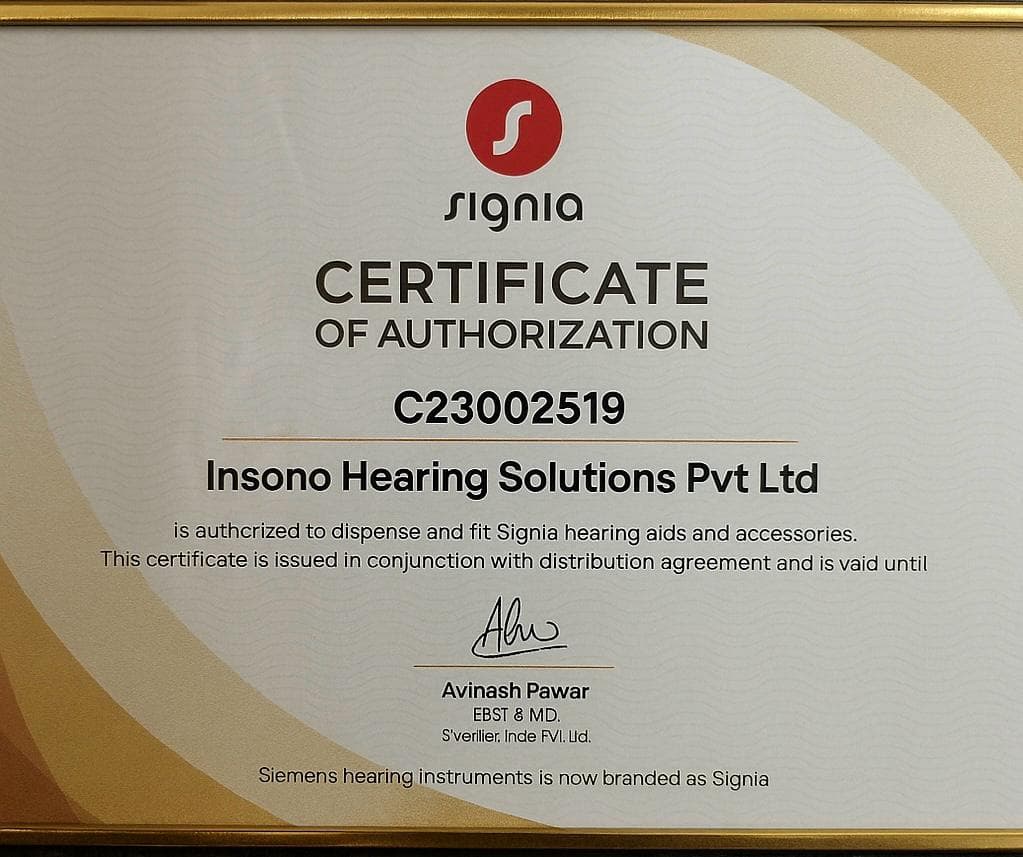
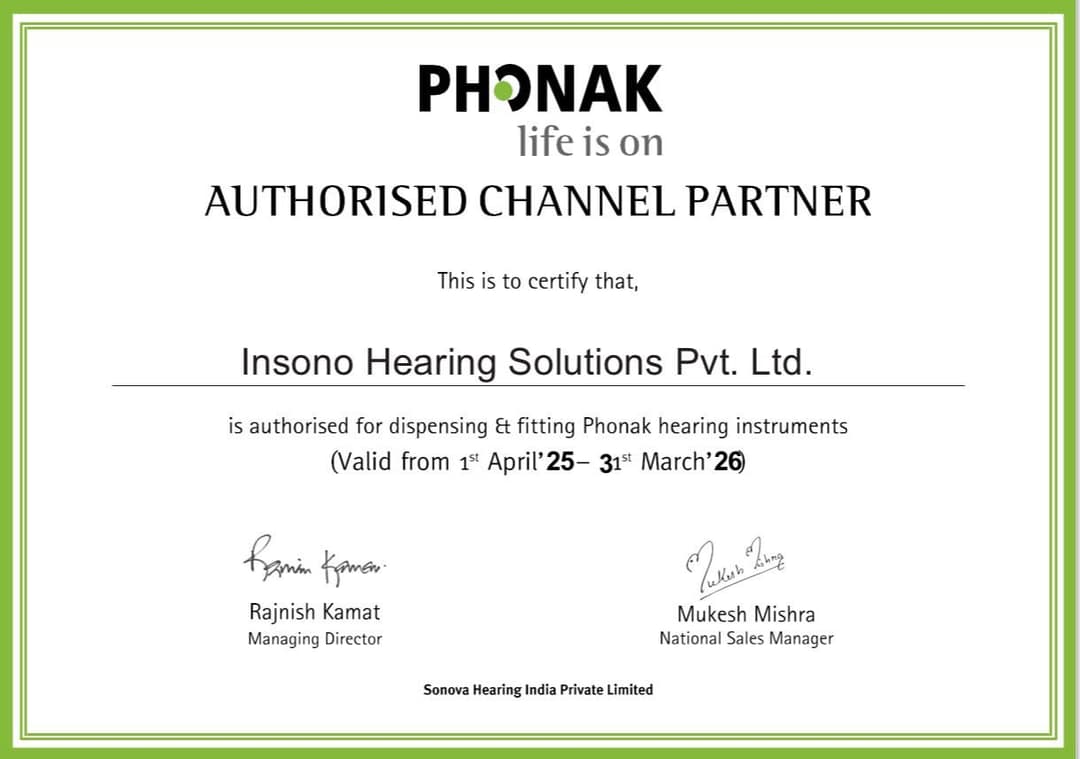
Official Certifications from Widex, Signia & Phonak
Insono Hearing Solutions is an authorized partner for leading global hearing aid brands including Widex, Signia, Phonak, and Oticon. These certifications reflect our trusted expertise and commitment to world-class hearing care in India.

Discover the Different Types of Hearing Aids for Better Hearing
Learn about the latest digital hearing aids, from behind-the-ear (BTE) to completely-in-canal (CIC) devices. Find the right style, features, and comfort level that suit your lifestyle.