Oticon
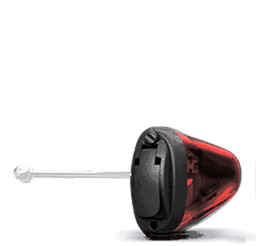
OTICON ACTO D ITC (WL) In-The-Canal (ITC) Hearing Aid
₹80,000MRP
Technology
AI-PoweredNoise CancellationTinnitus Masking
Style
ITC
Available Colors
BlackSandy BrownBrownBeigeDark ChampagneBlack GlossDeep Brown
Suitable For
Mild Hearing LossModerate Hearing LossSevere Hearing Loss
✅ Free 3-day home trial·🚚 Cash on delivery·🛡️ Genuine warranty
The OTICON ACTO D ITC (WL) is a discreet, custom-made In-The-Canal (ITC) digital hearing aid designed for people who want effective hearing support in a compact and less visible form. Developed as part of the Oticon Acto family, this hearing instrument combines Oticon’s RISE 2 digital processing platform with practical sound-processing and listening-support technologies designed to improve everyday communication.
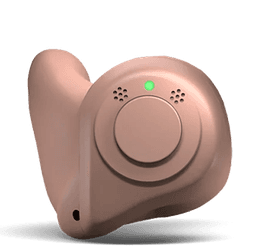
The ITC style is positioned partly inside the ear canal, making it considerably more discreet than traditional behind-the-ear hearing aids. At the same time, its slightly larger custom shell compared with very small CIC or IIC designs can provide useful space for controls, electronics, wireless functionality and a larger battery configuration, depending on the exact version and fitting.
Oticon's published Acto documentation identifies the standard Acto configuration with 6 fitting bands, 8 kHz fitting bandwidth, Binaural Coordination, Dynamic Feedback Cancellation 2, DecisionMaker2, in-situ audiometry, NAL-NL1/NAL-NL2 and DSL v5.0a m[i/o] fitting options, memory, AutoPhone and ConnectLine compatibility.
Because the Acto generation is an older Oticon platform, exact specifications can depend on the individual ITC configuration, shell, receiver/electronic configuration and fitting setup. Therefore, the final fitting range, battery life and accessory compatibility should be confirmed from the particular device and audiologist's fitting software.
In-The-Canal Custom Design
One of the main advantages of the OTICON ACTO D ITC (WL) is its custom in-the-ear design. Unlike conventional BTE hearing aids, the main hearing-aid housing is positioned within the ear rather than behind the ear.
The custom shell is manufactured to fit the individual's ear anatomy. A properly fitted ITC device can provide a secure and comfortable fit while keeping the hearing aid relatively discreet.
The position of the device can also make everyday handling convenient for many users. Depending on the configuration, the wearer may have access to controls such as a volume control or program button without needing to reach behind the ear.
The exact appearance depends on the ear impression, shell design, colour and electronics selected during fitting.
RISE 2 Digital Processing Platform
The OTICON ACTO D ITC (WL) is based on Oticon's RISE 2 platform, a digital hearing-aid processing platform used across the Acto family.
RISE 2 provides the digital processing foundation for amplification, sound management, feedback control and other hearing-support functions. The objective is to process incoming sounds and apply the prescribed amplification according to the user's hearing loss and fitting settings.
The system is designed to provide access to important sounds while helping manage unwanted acoustic conditions. Since hearing loss differs from person to person, the hearing aid is programmed according to the user's audiogram and individual listening requirements rather than using a single universal amplification setting.
Six Fitting Bands
The standard Oticon Acto configuration provides 6 fitting bands.
Fitting bands allow the hearing-care professional to adjust amplification across different frequency regions. This is important because hearing loss is often not identical across all frequencies.
For example, one person may have relatively better low-frequency hearing but greater high-frequency hearing loss, while another person may have a different hearing profile. The six-band fitting structure gives the audiologist several frequency regions in which to customise gain and output.
The final fitting should always be based on a hearing assessment and professional verification.
8 kHz Fitting Bandwidth
Oticon's Acto documentation lists an 8 kHz fitting bandwidth.
Bandwidth refers to the frequency range available for fitting and amplification adjustments. Access to higher-frequency information can be particularly relevant to speech sounds and environmental sounds.
High-frequency speech information contributes to the distinction between many consonants. Appropriate amplification of these frequencies may therefore help some users obtain greater access to speech details, depending on their hearing loss, ear acoustics and individual fitting.
The 8 kHz specification should not be interpreted as a guarantee that every user will hear every high-frequency sound equally well. Real-world benefit depends on the individual's hearing condition and fitting.
Binaural Coordination
For users wearing hearing aids in both ears, coordination between the two instruments can be important.
The Acto family documentation lists Binaural Coordination as a feature of the standard Acto model.
Binaural coordination allows user controls and certain hearing-aid functions to work together across the two instruments when the devices are fitted as a compatible bilateral pair.
This can make everyday operation more convenient. For example, changes made to one hearing aid may be coordinated with the other depending on the function and configuration.
The exact operation depends on the programmed settings and the particular wireless configuration.
Dynamic Feedback Cancellation 2
Feedback is the whistling or squealing sound that can occur when amplified sound escapes from the ear and is picked up again by the hearing aid microphone.
The OTICON ACTO family incorporates Dynamic Feedback Cancellation 2 (DFC2).
DFC2 is designed to reduce the likelihood of acoustic feedback while maintaining useful amplification. This is especially relevant for people who require amplification in frequencies where feedback can otherwise become more noticeable.
Effective feedback management can contribute to a more comfortable hearing experience and can help the hearing professional achieve an appropriate fitting.
However, feedback can still occur in certain circumstances, particularly when an ear mould or custom shell is not fitting correctly, when the hearing aid is handled close to the ear, or when there is a change in the physical fit.
DecisionMaker2
The Acto family documentation identifies DecisionMaker2 among its sound-processing features.
DecisionMaker2 is intended to help the hearing instrument make appropriate processing decisions according to the surrounding acoustic situation.
Real life contains constantly changing sounds. A quiet conversation, a busy street, television viewing and a restaurant environment do not present the same acoustic conditions.
Automatic processing can therefore reduce the need for the wearer to constantly adjust the hearing aid manually.
Noise Management
The Acto family includes automatic sound-management capabilities designed to respond to changing listening conditions. The product documentation distinguishes the standard Acto configuration from Acto Pro, with Acto offering its own noise-management and directionality configuration rather than the more advanced Pro feature set.
Noise management is particularly relevant when the wearer moves between quiet and noisy environments.
For example, background noise may be present in:
Restaurants
Family gatherings
Shops
Offices
Public transport
Outdoor environments
Social events
Busy streets
The purpose of noise-management processing is not simply to make the environment silent. Instead, the hearing aid processes the acoustic scene to help provide a more manageable listening experience while maintaining access to important sounds.
Directionality
The Acto family incorporates directional microphone technology, with the exact implementation depending on the model and configuration. Oticon's Acto documentation lists directionality among the family's sound-management features.
Directional processing can be useful when the person is facing a speaker while background sound is coming from other directions.
For example, during a face-to-face conversation in a moderately noisy environment, directional processing may help the hearing instrument focus more strongly on sound coming from the front.
Directionality is not intended to eliminate all surrounding sound. Maintaining awareness of the surrounding environment can remain important for safety and natural interaction.
Automatic Adaptation
The Acto platform is designed to adapt hearing-aid operation according to listening conditions. Automatic adaptation can reduce the amount of manual adjustment required during daily use.
This is useful for users who move frequently between different acoustic environments.
Instead of constantly changing programs or volume settings, the hearing aid can use its programmed processing strategies to respond to changing sound conditions.
The precise level of automatic adaptation depends on the programmed configuration.
NAL and DSL Fitting Options
Oticon's published Acto documentation lists NAL-NL1, NAL-NL2 and DSL v5.0a m[i/o] among the fitting options.
These fitting approaches help hearing-care professionals establish appropriate amplification targets based on the user's hearing thresholds and fitting requirements.
The audiologist can then fine-tune the hearing aid according to the individual's:
Audiogram
Hearing needs
Listening environments
Comfort preferences
Speech understanding
Experience with hearing aids
Professional fitting is particularly important because two people with similar audiograms may have different listening requirements.
In-Situ Audiometry
The Acto family supports in-situ audiometry.
In-situ audiometry allows hearing-related measurements to be incorporated into the hearing-aid fitting process using the hearing instrument itself, where supported by the fitting system.
This can help the hearing professional refine the fitting according to the user's measured responses.
It is one of the tools available to support individualised hearing-aid programming.
Memory and User Programs
The Acto family provides memory functions and user-program options. Oticon's product documentation lists memory and four user programs among the family features.
Programs can be configured by the hearing-care professional for different listening situations.
Depending on the individual configuration, programs may be used to provide different processing settings for environments such as:
General everyday listening
Noisy environments
Telephone use
Special listening situations
The available programs and their functions depend on the exact fitting.
AutoPhone
The Acto family includes an AutoPhone program.
Telephone conversations can sometimes be challenging for hearing-aid users because the phone receiver is placed close to the hearing-aid microphone.
An AutoPhone function can help the hearing aid respond appropriately when the telephone is used, depending on the device configuration and programming.
This can make regular telephone conversations more convenient for users who frequently communicate by phone.
ConnectLine Compatibility
Oticon's Acto documentation identifies the Acto family as ConnectLine enabled.
ConnectLine was Oticon's accessory-based connectivity ecosystem for compatible hearing instruments. Depending on the specific Acto configuration and available accessories, ConnectLine could provide access to phones, televisions and other audio sources.
It is important to distinguish this older accessory-based connectivity from modern hearing aids that offer direct Bluetooth streaming. The OTICON ACTO D ITC (WL) should not automatically be marketed as having modern direct Bluetooth connectivity simply because it is labelled wireless.
Compatibility should be checked against the exact Acto device and accessory.
DAI and FM Compatibility
The Acto family documentation also identifies DAI and FM compatibility.
These technologies can be useful in specialised communication situations.
Direct Audio Input can allow an appropriate audio source to feed sound into a compatible hearing instrument. FM systems can provide additional assistance in situations where a remote speaker's voice needs to reach the listener more clearly.
Such systems can be particularly relevant in educational, professional or specialised communication environments, subject to compatible equipment.
Discreet ITC Appearance
For users who prefer a hearing aid that is less visible than a conventional behind-the-ear model, an ITC design can be an attractive option.
The OTICON ACTO D ITC (WL) is positioned within the ear, with only a portion of the device visible externally.
The final visibility depends on:
Ear canal size
Ear anatomy
Shell design
Hearing-loss requirements
Battery configuration
Control options
Individual impression
Therefore, the actual appearance should be demonstrated during the fitting consultation rather than guaranteed in advance.
Custom-Made Comfort
Because the device is made for the user's ear, the shell can be customised to the individual's anatomy.
A correctly made and professionally fitted shell should sit securely without excessive movement. Proper fit is also important for acoustic performance and feedback control.
Users should not attempt to modify the shell themselves. If the device feels loose, painful, excessively tight or uncomfortable, it should be assessed by the hearing-care professional.
Everyday Speech Support
The main objective of a hearing aid is to provide appropriately amplified access to sound.
The OTICON ACTO D ITC (WL) is designed to support everyday listening through digital amplification, frequency-specific fitting, feedback management, directional processing and automatic sound-management functions.
It can be used in many ordinary communication situations, including conversations with family members, speaking with colleagues, shopping, watching television and participating in social activities.
However, hearing aids do not restore normal hearing or eliminate hearing loss. Outcomes depend on the degree and type of hearing loss, fitting accuracy, auditory experience, environment and consistent use.
Who May Consider the OTICON ACTO D ITC (WL)?
The OTICON ACTO D ITC (WL) may be considered by adults who:
Prefer an in-the-ear hearing-aid style
Want a relatively discreet hearing solution
Prefer not to wear a traditional behind-the-ear device
Require individually programmed amplification
Want automatic sound-processing support
Experience difficulty understanding speech in everyday environments
Need feedback-management technology
Want access to Oticon's RISE 2 platform
May benefit from bilateral coordination when using two compatible instruments
Prefer a custom-made ear fitting
The final suitability should always be determined by an audiologist or hearing-care professional after reviewing the person's hearing test and lifestyle requirements.
Important Technical Note About the Wireless Version
The designation "(WL)" refers to the wireless-enabled configuration within the Acto family. The published Acto documentation identifies wireless functionality, Binaural Coordination and ConnectLine compatibility among the relevant features.
However, this should not be confused with the direct 2.4 GHz Bluetooth technology found in many newer Oticon hearing aids.
For an older Acto device, connectivity may require compatible Oticon accessories such as ConnectLine equipment. Availability and compatibility should therefore be confirmed before promising smartphone, television or other direct-streaming functionality.
Battery and Daily Handling
The exact battery specification can vary according to the particular Acto ITC configuration.
Battery life depends on factors such as:
Battery size
Amount of amplification
Daily wearing time
Program settings
Wireless use
Streaming or accessory use
Individual hearing requirements
Users should follow the battery recommendation supplied with their specific hearing instrument.
Batteries should be kept away from children and pets. When the hearing aid is not being used, the appropriate storage procedure should be followed.
Cleaning and Maintenance
Regular cleaning is essential for reliable performance.
Users should keep the hearing aid free from:
Earwax
Moisture
Dust
Hair products
Cosmetics
Excessive perspiration
The microphone openings, sound outlet and vent should be inspected regularly. Earwax accumulation can reduce sound output or contribute to feedback.
The hearing aid should not be washed with water or exposed to excessive moisture unless specifically designed and rated for that use.
Professional cleaning and servicing should be arranged when required.
Professional Fitting Is Essential
A hearing aid should never be selected only on the basis of its model name.
The audiologist should evaluate:
Pure-tone hearing thresholds
Speech understanding
Ear anatomy
Hearing-loss configuration
Listening environments
Previous hearing-aid experience
Comfort preferences
Telephone requirements
Bilateral or unilateral use
Connectivity requirements
After programming, the professional can make additional adjustments based on the user's real-world experience.
A hearing aid that is correctly programmed for the individual can provide a substantially different experience from an instrument that has not been properly fitted.
Key Features at a Glance
Model: OTICON ACTO D ITC (WL)
Style: In-The-Canal (ITC)
Platform: RISE 2
Fitting Bands: 6
Fitting Bandwidth: 8 kHz
Binaural Coordination: Yes
Dynamic Feedback Cancellation 2: Yes
DecisionMaker2: Yes
In-Situ Audiometry: Yes
Fitting Formulas: NAL-NL1, NAL-NL2 and DSL v5.0a m[i/o]
Memory: Yes
User Programs: Up to four listed in Acto family documentation
AutoPhone: Yes
ConnectLine: Supported
DAI/FM: Supported
Wireless Configuration: Available depending on specific model/configuration
These specifications are based primarily on Oticon's published Acto family documentation; exact ITC configuration, fitting range, battery and accessory compatibility should be verified for the individual instrument.
Advantages of an ITC Hearing Aid
An ITC hearing aid offers a useful balance between discretion, handling and functionality.
Compared with larger behind-the-ear devices, the OTICON ACTO D ITC (WL) places most of the electronics inside the ear. This can make it less noticeable during everyday conversations.
Compared with extremely small CIC or IIC devices, an ITC can offer more physical space for controls and electronics while remaining relatively discreet.
The choice between ITC, CIC, IIC, BTE and RITE/RIC should ultimately depend on hearing loss, ear anatomy, dexterity, lifestyle and desired features.
Final Summary
The OTICON ACTO D ITC (WL) is a custom In-The-Canal digital hearing aid developed around Oticon's RISE 2 platform. It combines a discreet custom ear design with practical digital hearing-aid features intended to support everyday communication.
Its published Acto configuration includes 6 fitting bands and an 8 kHz fitting bandwidth, along with Binaural Coordination, Dynamic Feedback Cancellation 2, DecisionMaker2, in-situ audiometry, multiple fitting formulas, memory, user programs and AutoPhone functionality. The family also supports ConnectLine, DAI and FM functionality, depending on the exact configuration and accessories.
The ITC design makes the device suitable for users who prefer a hearing aid positioned inside the ear rather than behind the ear. Its custom construction can provide a secure and discreet fit when properly manufactured and fitted.
As an older-generation Oticon hearing instrument, it should be presented accurately without attributing modern features such as direct Bluetooth streaming or newer Oticon processing technologies that are not part of the Acto platform.
For the best result, the OTICON ACTO D ITC (WL) should be selected and programmed following a complete hearing evaluation. The audiologist can determine whether its amplification capability, physical design, wireless configuration and available accessories are appropriate for the user's hearing loss and daily communication requirements.
More Oticon Hearing Aids
OTICON GO PRO D VC / GO PRO D Behind-The-Ear (BTE) Hearing Aid
OTICON GO PRO POWER D Behind-The-Ear (BTE) Hearing Aid
OTICON GO PRO D In-The-Canal (ITC) Hearing Aid
OTICON GO PRO In-The-Canal (ITC) Hearing Aid
OTICON GO PRO PB Completely-In-Canal (CIC) Hearing Aid
OTICON GO PRO PB POWER Behind-The-Ear (BTE) Hearing Aid
OTICON GO PRO D VC / GO PRO D Behind-The-Ear (BTE) Hearing Aid
OTICON GO PRO POWER D Behind-The-Ear (BTE) Hearing Aid
OTICON GO PRO D In-The-Canal (ITC) Hearing Aid
OTICON GO PRO In-The-Canal (ITC) Hearing Aid
OTICON GO PRO PB Completely-In-Canal (CIC) Hearing Aid
OTICON GO PRO PB POWER Behind-The-Ear (BTE) Hearing Aid
Frequently Asked Questions
What is a Oticon hearing aid?▼
Oticon is a world-leading hearing aid brand known for its advanced technology, exceptional sound quality, and reliability. The OTICON ACTO D ITC (WL) In-The-Canal (ITC) Hearing Aid is one of their premium models designed to help people with hearing loss experience clear, natural sound.
What technology does the OTICON ACTO D ITC (WL) In-The-Canal (ITC) Hearing Aid use?▼
The OTICON ACTO D ITC (WL) In-The-Canal (ITC) Hearing Aid features AI-Powered, Noise Cancellation, Tinnitus Masking. These technologies work together to deliver outstanding clarity, comfort, and connectivity for the wearer.
What is the style and shape of the OTICON ACTO D ITC (WL) In-The-Canal (ITC) Hearing Aid ?▼
The OTICON ACTO D ITC (WL) In-The-Canal (ITC) Hearing Aid is available in ITC style(s). This style balances comfort, discretion, and performance.
What level of hearing loss is the OTICON ACTO D ITC (WL) In-The-Canal (ITC) Hearing Aid suitable for?▼
The OTICON ACTO D ITC (WL) In-The-Canal (ITC) Hearing Aid is recommended for individuals with Mild Hearing Loss, Moderate Hearing Loss, Severe Hearing Loss. We advise getting a professional hearing assessment to confirm the best solution for your specific needs.
What is the price of the OTICON ACTO D ITC (WL) In-The-Canal (ITC) Hearing Aid ?▼
The OTICON ACTO D ITC (WL) In-The-Canal (ITC) Hearing Aid is priced at ₹80,000. Insono Hearing offers flexible EMI options and financing. Contact us for the latest offers and to schedule a free trial.
Where can I get a free trial of the OTICON ACTO D ITC (WL) In-The-Canal (ITC) Hearing Aid in India?▼
Insono Hearing offers free trials for the OTICON ACTO D ITC (WL) In-The-Canal (ITC) Hearing Aid at our clinics. Book an appointment online or call us to experience the device before making a decision.
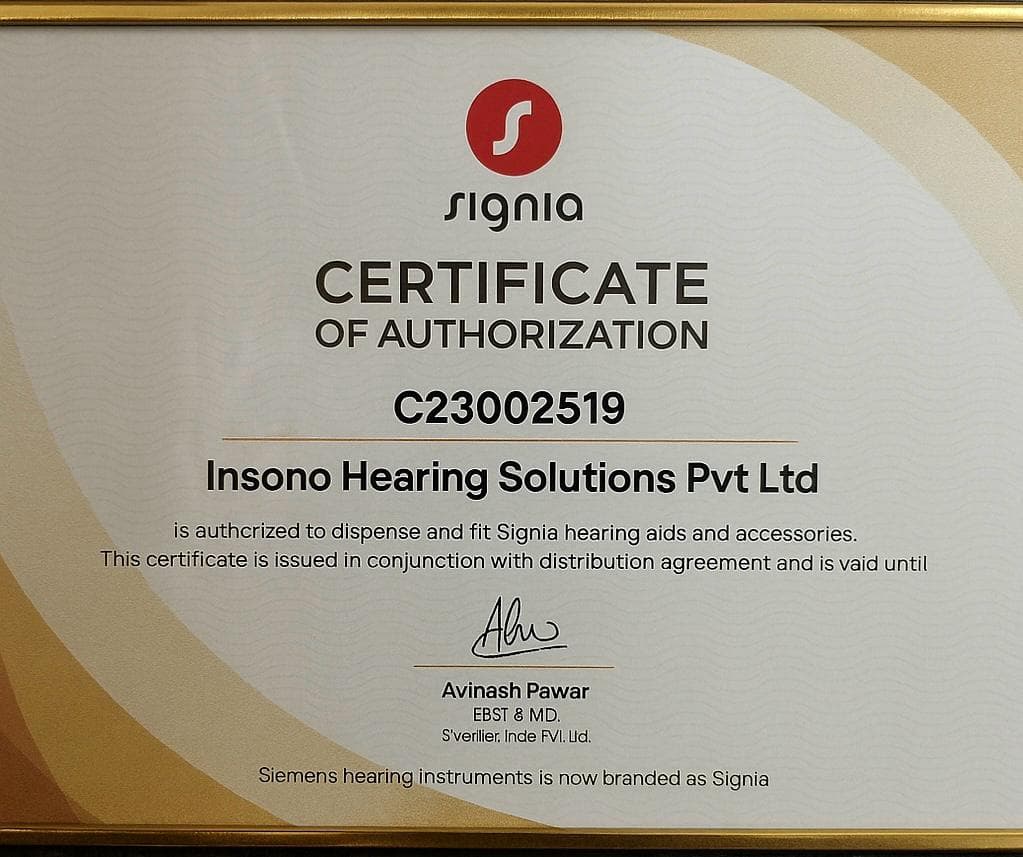
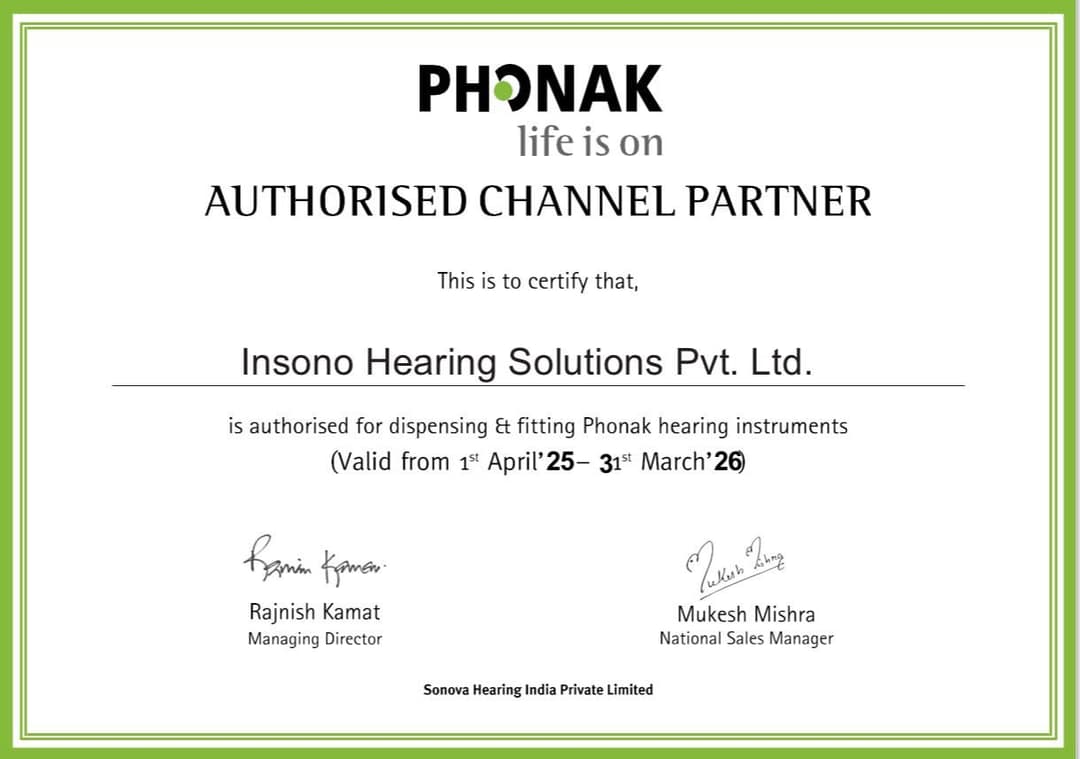
Official Certifications from Widex, Signia & Phonak
Insono Hearing Solutions is an authorized partner for leading global hearing aid brands including Widex, Signia, Phonak, and Oticon. These certifications reflect our trusted expertise and commitment to world-class hearing care in India.

Discover the Different Types of Hearing Aids for Better Hearing
Learn about the latest digital hearing aids, from behind-the-ear (BTE) to completely-in-canal (CIC) devices. Find the right style, features, and comfort level that suit your lifestyle.