Senior Audiologist • 8/19/2026

Most hearing aid guides assume hearing loss affects both ears fairly equally. But for a significant number of people, that’s simply not the case they have good or usable hearing in one ear, and little to no hearing in the other. This is often called single-sided deafness (SSD) or asymmetric hearing loss, and it comes with a very specific set of challenges that a regular hearing aid can’t fully solve.
That’s exactly where Phonak CROS and BiCROS hearing systems come in. In this guide, we’ll cover:
If you suspect you or a family member might benefit from this technology, you can browse Phonak’s full range on the Phonak hearing aids , check current pricing on the hearing aid price list, or book a free consultation directly through Insono Hearing’s appointment .
When someone has normal (or near-normal) hearing in one ear and severe-to-profound hearing loss in the other, a standard hearing aid fitted on the weaker ear usually doesn’t help much because the inner ear on that side often can’t process amplified sound clearly, no matter how much it’s boosted.
This creates real, everyday difficulties:
This is precisely the gap that CROS and BiCROS technology is designed to close.
CROS stands for Contralateral Routing of Signal. It’s built for people who have normal or near-normal hearing in one ear, and no usable hearing in the other.
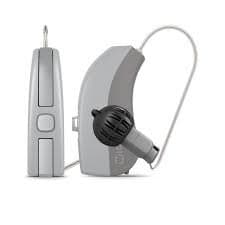
A small transmitter device is worn on the ear with no usable hearing. It picks up sound from that side and wirelessly sends it across to a receiver worn on the better-hearing ear. Since the better ear already hears normally, the receiver on that side doesn’t amplify it simply relays the sound it’s given, so the wearer now has awareness of sound from both sides, funneled into the one ear that can actually use it.
BiCROS stands for Bilateral Contralateral Routing of Signal. It’s designed for people who have no usable hearing in one ear, and some degree of hearing loss (not normal hearing) in the other ear as well.
The setup looks similar to CROS — a transmitter on the non-hearing ear picks up sound and sends it across wirelessly. The key difference is on the receiving side: instead of a simple relay receiver, the wearer uses an actual hearing aid on their better ear, which both amplifies their own hearing loss and receives the streamed signal from the weaker side. In other words, BiCROS combines two jobs in one device treating the hearing loss in the “better” ear while also picking up sound from the “dead” ear.
Phonak doesn’t sell a separate “BiCROS” branded transmitter — the same CROS I-R or CROS L-R transmitter is used. What changes is the receiving device: instead of pairing it with a non-amplifying receiver, it’s paired with a compatible amplifying Phonak hearing aid (such as an Audéo L-R, Audéo R Infinio, or Naída L-PR model) on the better ear. Your audiologist will determine the exact hearing aid model and technology level needed based on your hearing test results — you can browse the full range on the Phonak hearing aids page.
| Device | Compatible Platform | MRP (₹) |
|---|---|---|
| CROS I-R | Audéo R Infinio | ₹58,000 |
| CROS L-R | Audéo L-R / Naída L-PR | ₹55,000 |
Since BiCROS uses the same CROS transmitter paired with a hearing aid rather than a plain receiver, the total system cost equals the transmitter price plus the chosen hearing aid’s price. Here’s the full breakdown across technology levels:
BiCROS with CROS I-R + Audéo R Infinio (per unit, incl. charger)
| Hearing Aid Level | Hearing Aid MRP (₹) | Total BiCROS System (₹) |
|---|---|---|
| Audéo I 90-R | ₹3,47,000 | ₹4,05,000 |
| Audéo I 70-R | ₹2,34,000 | ₹2,92,000 |
| Audéo I 50-R | ₹1,40,000 | ₹1,98,000 |
| Audéo I 30-R | ₹89,000 | ₹1,47,000 |
BiCROS with CROS L-R + Audéo L-R (per unit, incl. charger)
| Hearing Aid Level | Hearing Aid MRP (₹) | Total BiCROS System (₹) |
|---|---|---|
| Audéo L90-R | ₹3,25,000 | ₹3,80,000 |
| Audéo L70-R | ₹2,20,000 | ₹2,75,000 |
| Audéo L50-R | ₹1,30,000 | ₹1,85,000 |
| Audéo L30-R | ₹79,000 | ₹1,34,000 |
BiCROS with CROS L-R + Naída L-PR (per unit, incl. charger — recommended for more severe hearing loss on the better ear)
| Hearing Aid Level | Hearing Aid MRP (₹) | Total BiCROS System (₹) |
|---|---|---|
| Naída L90-PR | ₹3,23,000 | ₹3,78,000 |
| Naída L70-PR | ₹2,18,000 | ₹2,73,000 |
| Naída L50-PR | ₹1,28,000 | ₹1,83,000 |
| Naída L30-PR | ₹77,000 | ₹1,32,000 |
| Feature | CROS | BiCROS |
|---|---|---|
| Ear with no usable hearing | Transmitter | Transmitter |
| Better-hearing ear condition | Normal / near-normal hearing | Some hearing loss present |
| Device on better ear | Non-amplifying receiver | Actual hearing aid (amplifies + receives) |
| Goal | Route sound from the “dead” side to the working ear | Route sound from the “dead” side, and treat hearing loss in the working ear |
| Typical candidate | Single-sided deafness with one fully normal ear | Asymmetric hearing loss in both ears |
This technology isn’t for everyone with hearing loss — it’s specifically for a defined group of candidates:
A proper diagnostic hearing test is essential before choosing between CROS and BiCROS — this isn’t a decision to make on your own, since the wrong fitting won’t provide the intended benefit.
You can find your nearest fitting center on the our clinics page, or book a hearing assessment directly through the appointment page.

Q1. What’s the difference between CROS and BiCROS in simple terms? CROS is for people with one completely normal ear and one non-functional ear — sound is simply routed from the bad side to the good side. BiCROS is for people with one non-functional ear and some hearing loss in the “better” ear too — so that ear needs both amplification and the routed signal.
Q2. Will a CROS device restore hearing in my deaf ear? No. CROS and BiCROS don’t restore hearing in the non-functional ear — they route sound from that side to your functioning ear, giving you awareness of sound from both directions rather than true hearing in the deaf ear.
Q3. Can I try a CROS/BiCROS system before committing to buy? Most audiology clinics, including Insono Hearing, offer a trial period so you can experience the real-world difference before making a purchase decision. Ask your audiologist about this when booking your appointment.
Q4. Is CROS/BiCROS covered by insurance in India? Coverage varies by insurer and policy. It’s best to check directly with your insurance provider, and your audiologist can usually provide the documentation needed for a claim.
Q5. How long does it take to adapt to a CROS/BiCROS system? Most users adapt within a few weeks, though the exact timeline varies. Your brain needs to relearn how to process sound coming from a new “direction” via the routed signal, so patience and follow-up fine-tuning sessions matter.
Q6. Are Phonak CROS devices compatible with all Phonak hearing aids? No — compatibility is model-specific. CROS I-R pairs with Audéo R Infinio, while CROS L-R pairs with Audéo L-R and Naída L-PR. Check the Phonak hearing aids range or ask your audiologist to confirm which combination suits your hearing loss.
Q7. Where can I check the latest official prices and buy genuine Phonak CROS devices? Always purchase through an authorized audiologist or clinic to ensure genuine hardware and warranty coverage. You can check current pricing on the hearing aid price list or reach out via Insono Hearing’s contact page.